10 best loan origination software in 2026
If you search “10 best loan origination software” or “top loan origination software”, you’ll get hundreds of different blog posts, articles, and vendor websites touting the answer. Everyone has strong opinions and nobody agrees on what “best” actually means.
The reality is loan origination software has never been more crowded, which is further complicated by the messy reality of different types of vendors in this space. Mortgage-only tools, decisioning-only tools, front-end application builders, and full lifecycle platforms all call themselves loan origination software, despite solving very different problems.
This makes evaluating the top loan origination software much harder than it looks on the surface. Every vendor claims speed, flexibility, and “next-generation” architecture, but only a handful actually deliver it at scale.
This guide attempts to cut through the confusion by comparing 10 solutions shaping modern loan origination. And yes, we’re starting with LoanPro because we wrote the list — and LoanPro has proven scale working with more than 600 lenders, advanced capabilities, and a complete end-to-end solution that takes you from origination to servicing.
Each loan origination platform has unique strengths and specific use cases. For instance, if you're a mortgage lender, Encompass probably belongs at the top of your list. Our goal is to help you understand the landscape to make the best choice for your business even if it’s not LoanPro.
How we evaluated the top loan origination software
Our evaluation drew from customer reviews on G2, Capterra, and Gartner, publicly available case studies, comparable lists from other sites, and vendor documentation. We assessed each one across five dimensions: product scope (origination vs. lifecycle), configurability, integration architecture, target customer segment, and real-world scalability.
In this guide, we evaluate:
LoanPro, Encompass, nCino, Blend, MeridianLink, Abrigo, TurnKey, Finastra, DigiFi, and LendAPI
Top 10 best loan origination systems in 2026
1. LoanPro
Best for end-to-end modern lending across origination and servicing
LoanPro is a modern, API-first lending platform that supports the full loan lifecycle, from origination through servicing, collections, and payments. It’s designed for lenders that need flexibility, scalability, and deep configurability across products.
Key strengths:
- Proven scalability with 600+ lenders across multiple asset classes
- True end-to-end platform covering origination, servicing, and payments
- Highly configurable loan products, workflows, and rules engine
- Robust API-first architecture for custom integrations and embedded finance
- Strong support for complex lending use cases (e.g., BNPL, credit lines, secured lending)
- Real-time, unified data access and ledger across the lifecycle
- Identity verifications for both consumers and businesses
- Model Context Protocol capabilities to connect servicing and collections data and operations with any AI model
Things to consider:
- Configuration depth may require initial learning curve for full platform optimization
- Implementation can be more involved than point solutions
- Established partner ecosystem supports rapid integrations; building API connections outside this ecosystem may require more technical planning
- UI/UX may require configuration depending on use case (though this can largely be accomplished without back-end coding.)
- Built for lenders with ambitions to scale, may exceed the needs of very small operations.
2. Encompass
Best for mortgage lenders needing a comprehensive loan origination system
Encompass is the default choice for many mortgage lenders offering deep functionality and compliance support, but limited flexibility beyond mortgage workflows.
Key strengths:
- Widely considered the industry standard for mortgage origination in the United States
- Deep compliance and regulatory support for mortgage workflows
- Large ecosystem of integrations and third-party services
- Mature, well-documented workflows for mortgage processes
- Broad adoption across banks, credit unions, and independent mortgage bankers (IMBs)
Things to consider:
- Specifically built for mortgage and does not serve multi-product lenders well.
- Legacy architecture can slow innovation and customization
- Complex or clunky UI and workflow management
- Can be costly and resource-intensive to maintain
3. nCino
Best for Salesforce-native bank operations
nCino is a cloud-based banking platform built on Salesforce that supports commercial, small business, and mortgage lending workflows.
Key strengths:
- Native integration with Salesforce CRM ecosystem
- Strong commercial and small business lending capabilities
- Workflow automation and document management
- Good visibility into pipeline and borrower relationships
- Designed for regulated financial institutions
- Scalable across multiple lending products
Things to consider:
- Heavy reliance on Salesforce increases cost and complexity
- Customization often requires Salesforce expertise
- Implementation timelines can be long
- Less flexible outside Salesforce-native environments
4. Blend
Best for front-end digital borrower experiences
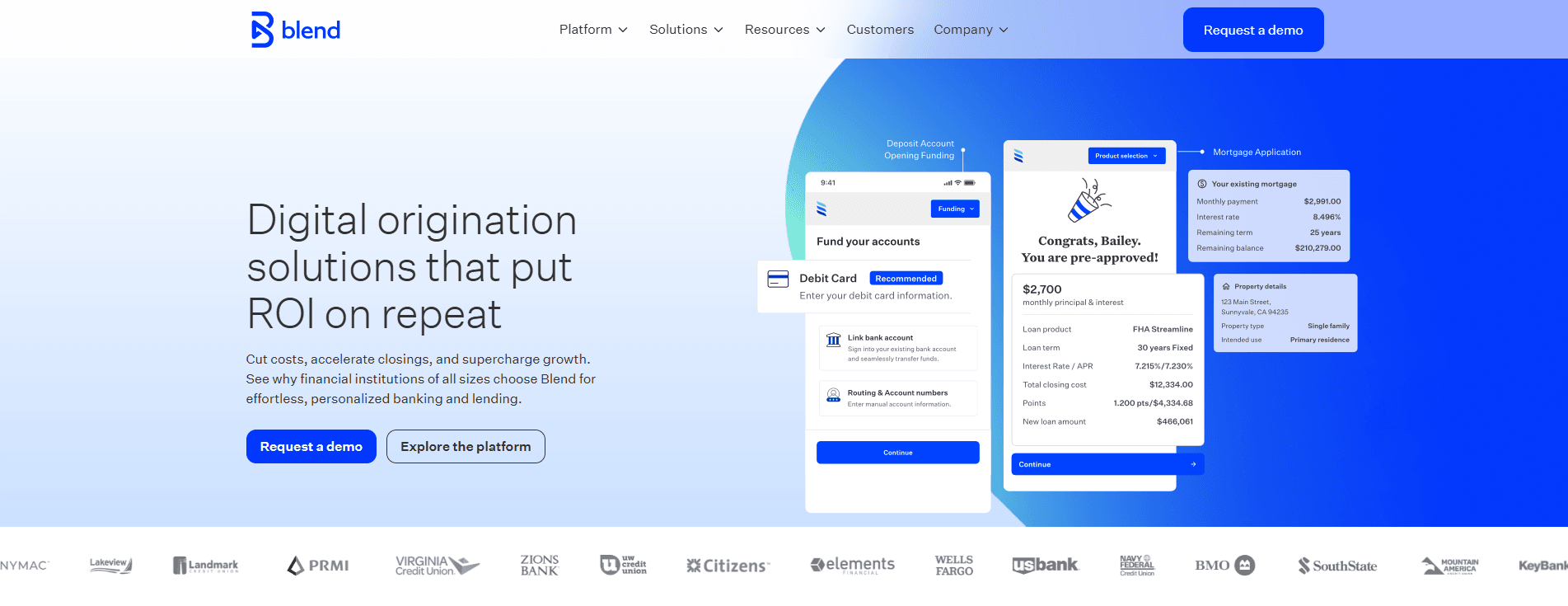
Blend focuses on borrower-facing application experiences, helping lenders streamline digital onboarding and application workflows.
Key strengths:
- Modern borrower user experience (UX) for digital applications
- Fast deployment for front-end origination workflows
- Built-in income and asset verification integrations
- Well-suited for mortgage and consumer lending front ends
- Continuous updates to user experience and flows
Things to consider:
- Not a full end-to-end LOS or servicing platform
- Requires integration with LOS and servicing systems
- Limited back-end workflow and servicing capabilities
- Dependency on other systems for full lifecycle management
5. MeridianLink
Best for credit union and community bank lending
MeridianLink is a widely used platform in the credit union and community bank market, offering solid functionality with less flexibility for highly customized lending models.
Key strengths:
- Supports consumer, mortgage, and indirect lending
- Integrated decisioning and data tools
- Relatively fast implementation for mid-sized institutions
- Pre-built integrations with credit bureaus and vendors
- Established reputation in the U.S. lending market
Things to consider:
- Limited flexibility for highly customized lending products
- UI and user experience can feel dated
- Less suited for large-scale or highly complex lenders
- Customization can require vendor involvement
6. Abrigo
Best for community banks focused on commercial lending
Abrigo provides lending and credit risk management software, with a focus on helping community banks and credit unions compete through automation.
Key strengths:
- Listed as G2 category leader for loan origination
- Designed for community banks and smaller institutions
- Strong emphasis on regulatory compliance and reporting
- Good support for commercial lending workflows
- Established presence in risk management software
Things to consider:
- Not seen as a modern, full-stack origination platform
- Requires steep learning curve to take full advantage of features
- Limited flexibility for digital-first lending experiences
- UI and workflow experience can be dated
- Less suited for consumer lending, fintech, or high-volume lenders
7. TurnKey Lender
Best for automated lending workflows with built-in decisioning
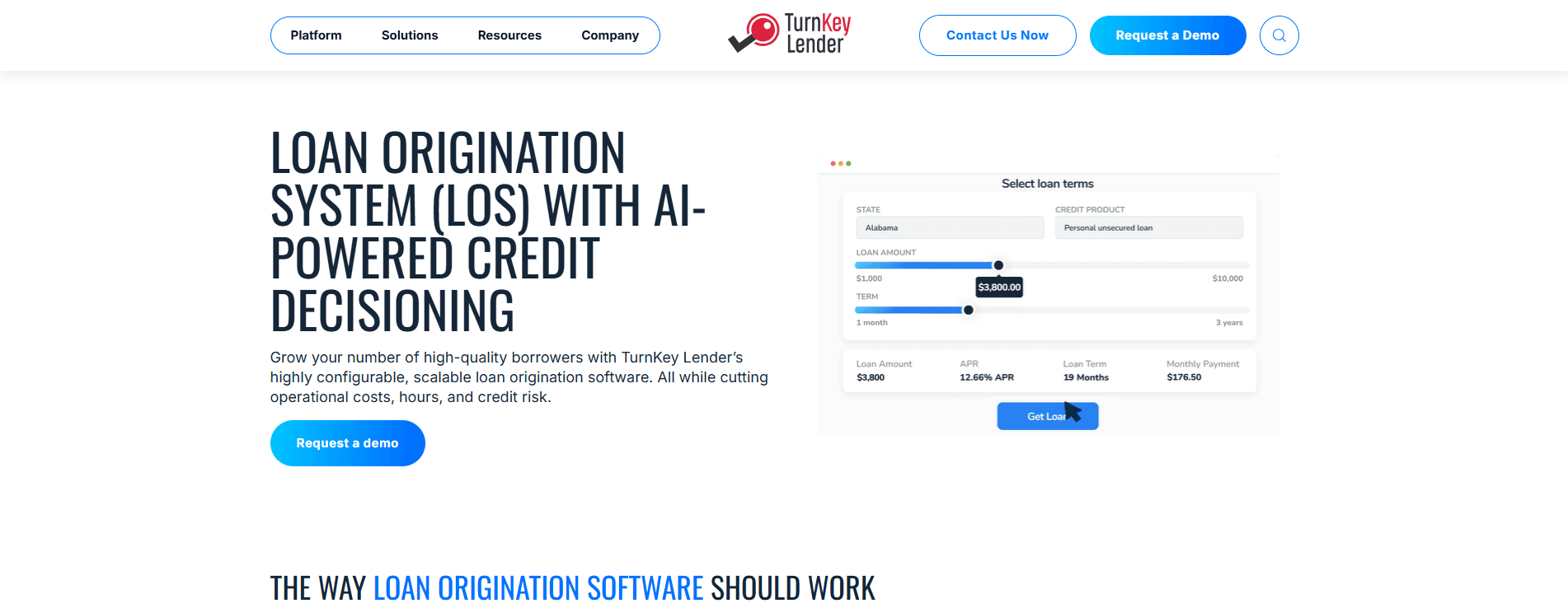
TurnKey Lender is a cloud-based lending platform focused on automation, decisioning, and AI-driven credit evaluation, prioritizing speed over deep customization.
Key strengths:
- Uses machine learning alongside rules-based decisioning
- Quicker deployment compared to legacy systems
- Built-in decisioning engine and scoring models
- Multi-language and multi-currency support
Things to consider:
- Customization can be limited compared to API-first platforms
- Limited adoption within large U.S. financial institutions
- Black-box nature of AI models may raise compliance concerns
- UI and configurability can vary by use case
- Potential limitations in document automation capabilities
8. Finastra
Best for large financial institutions needing broad banking systems
Finastra offers a wide range of financial software, including loan origination, as part of a broader banking technology suite. It provides comprehensive, cloud-based LOS through its Originate and Mortgagebot platforms, designed to streamline consumer, business, and mortgage lending.
Key strengths:
- Comprehensive suite across banking functions to support multiple lending products and geographies
- Market-leading position in commercial and syndicated lending
- Strong presence with large, global financial institutions
- Deep integration with core banking systems and enterprise financial infrastructure
- Established vendor with long-term market presence and an extensive partner ecosystem
- Established compliance and risk management frameworks built for regulated banking environments
Things to consider:
- Loan origination is one part of a much larger ecosystem
- Implementation can be complex and resource-intensive with significant professional services costs
- Slower innovation compared to newer fintech platforms
- Less flexible for highly customized workflows
9. DigiFi
Best for embedded finance and API-driven lending with little to no coding
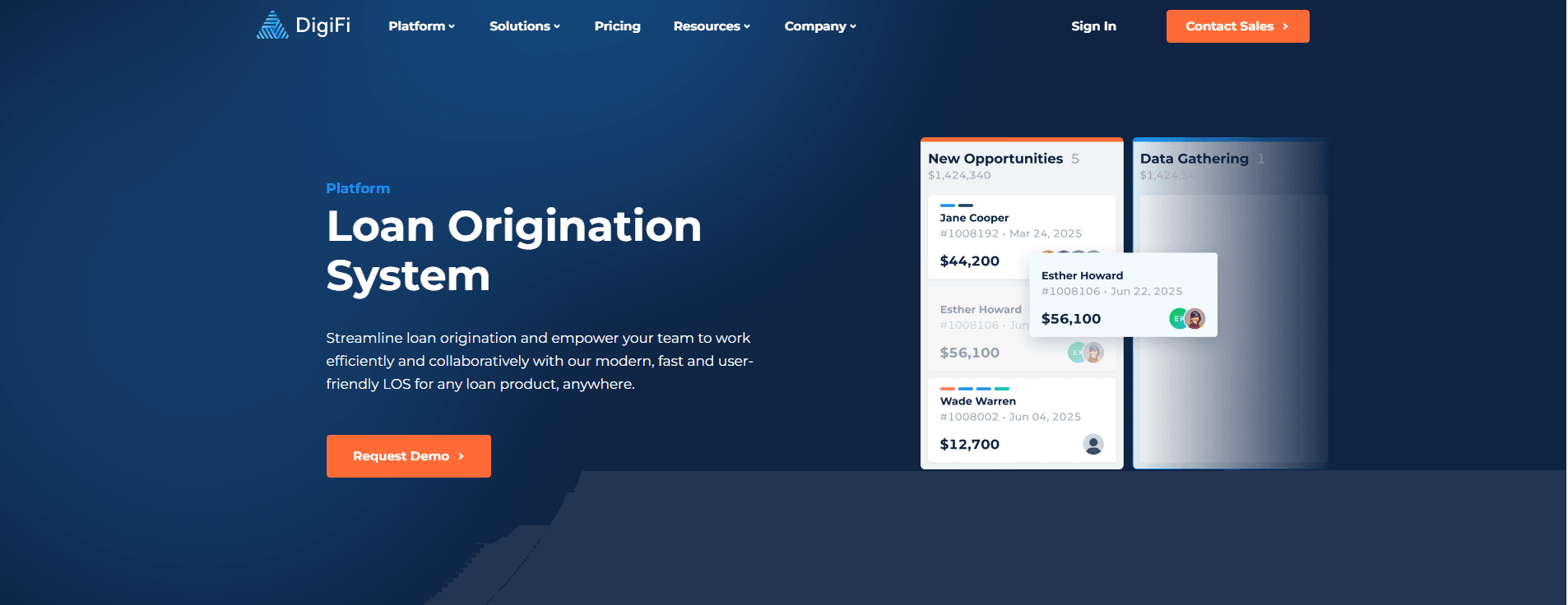
DigiFi provides an API-first lending infrastructure designed for embedded finance and fintech use cases.
Key strengths:
- Strong API-first architecture for embedded lending
- Supports multiple credit products and workflows
- Flexible integration into existing platforms
- Real-time decisioning and data capabilities
- Built for fintechs and digital-first lenders
- Scalable infrastructure for growth
Things to consider:
- Less brand recognition and proven enterprise scale compared to incumbents
- May require significant development resources
- Dashboard may slow down with large application volumes
- Limited out-of-the-box UI and reporting visualization compared to turnkey systems
- 24x5 customer support may not suffice for institutions requiring around-the-clock assistance
10. LendAPI
Best for lightweight, developer-first lending workflows
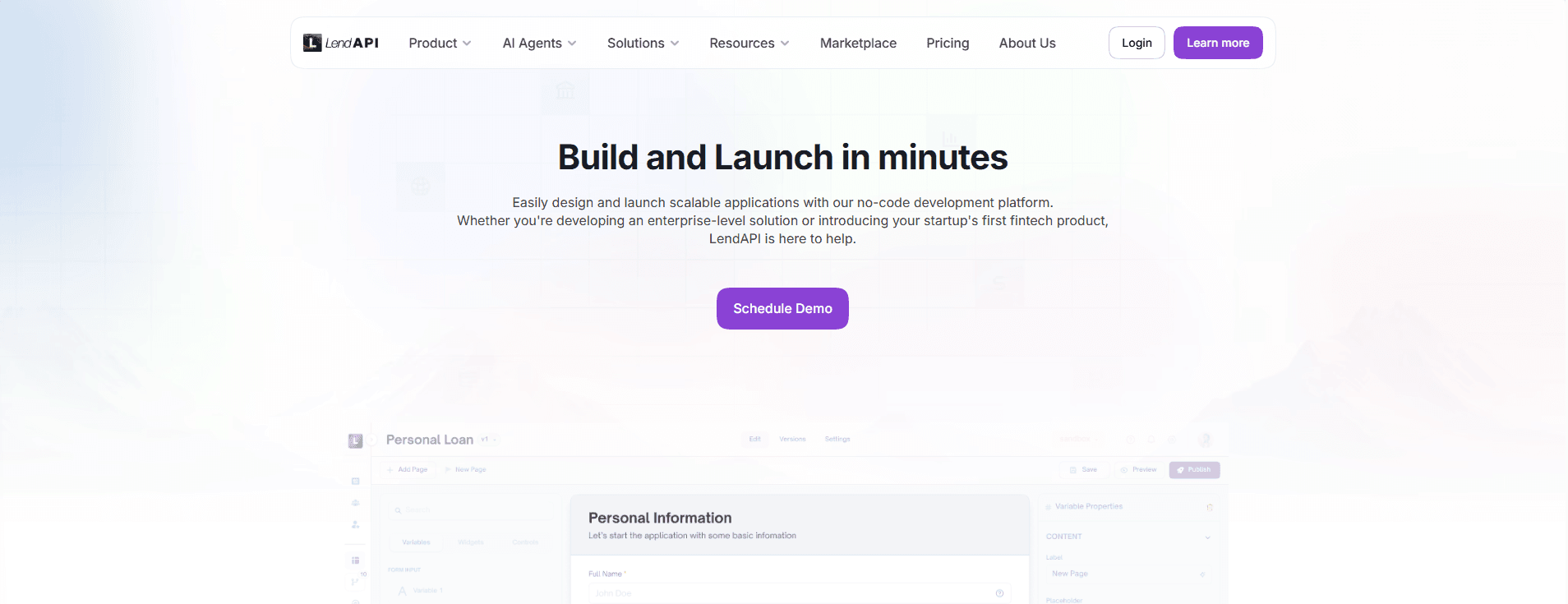
LendAPI focuses on providing modular APIs for building custom lending and credit products. It is not a LOS but rather, a way for companies to build, launch, and iterate on a custom LOS.
Key strengths:
- Developer-friendly APIs for rapid customization
- Lightweight and flexible architecture
- Supports embedded lending use cases
- Faster time to market for custom builds
- Good, low-cost fit for startups and fintech platforms
- Modular approach to lending functionality
Things to consider:
- Not a full-featured LOS out of the box
- Requires engineering resources to build complete workflows
- Limited enterprise track record
- May lack depth for complex regulatory environments
How to evaluate loan origination software for your institution
Beyond technology features and pricing models, evaluating loan origination systems should focus on ensuring the platform aligns with your specific operational, compliance, and security requirements to meet the unique needs of your business and customers. The 10 vendors listed above are a starting point but there are many others that were considered but not included here.
In addition, you should consider whether you need a single platform that unifies origination and servicing, or a combination of systems connected through integrations. This decision has a direct impact on data consistency, operational efficiency, and your ability to scale without adding complexity.
Why origination and servicing belong on the same platform
Historically, it made sense to treat origination and servicing as separate systems. Origination was about booking loans. Servicing was about managing them.
However, when origination and servicing live on different platforms, data fragmentation becomes unavoidable. Syncing key borrower information, loan terms, and transaction histories across systems creates operational overhead and limits real-time visibility.
A unified, modern lending platform changes that dynamic. When origination and servicing are connected, lenders gain a single source of truth across the entire loan lifecycle. Decisions made during underwriting can directly inform servicing strategies, collections workflows, and customer engagement.
It also improves speed and adaptability. Launching a new product, updating pricing models, or adjusting credit policies becomes significantly easier when those changes don’t need to be replicated across multiple systems. Platforms like LoanPro are built around this concept, enabling lenders to manage the full lifecycle without stitching together separate tools.
There’s also a meaningful impact on customer experience. Borrowers don’t think in terms of “origination” and “servicing.” They expect a seamless journey. Disconnected systems often lead to inconsistent communication, redundant data requests, and slower issue resolution.
That said, a unified approach isn’t always necessary. Some lenders intentionally choose best-of-breed systems like Blend for front-end experience or Encompass for mortgage specialization. But as lending models become more complex and real-time expectations increase, the tradeoffs of a fragmented stack become harder to ignore.
Frequently asked questions
What features should I look for in a loan origination system?
Key features include application intake, workflow automation, credit decisioning, document management, compliance tools, integrations, and reporting. More advanced platforms also offer APIs, real-time data access, and end-to-end lifecycle support.
What is the difference between loan origination and loan servicing?
Loan origination covers the process of creating and approving a loan. Loan servicing begins after funding and includes payment processing, interest calculations, collections, and customer account management.
Do I need an end-to-end platform or point solutions?
It depends on your business model. Point solutions can be faster to deploy and optimize for specific functions, while end-to-end platforms provide better data consistency, scalability, and long-term efficiency.
Can loan origination software integrate with my existing core banking system?
Yes. Most modern loan origination systems are designed to integrate with core banking platforms, but the level of effort varies significantly. Some vendors offer pre-built integrations with common cores, while others rely on APIs for custom connections.
API-first platforms like LoanPro or DigiFi typically provide more flexibility and real-time data exchange, which can reduce long-term integration friction. More traditional systems, including Finastra or nCino, may integrate more directly within established banking ecosystems but can require additional configuration or middleware.
What should I look for in loan origination software for a credit union?
Credit unions typically need loan origination software that balances ease of use, compliance, and cost efficiency while still supporting a range of lending products.
Key considerations include strong support for consumer and indirect lending, built-in compliance tools, and pre-configured workflows that align with credit union operations. Platforms like MeridianLink and Abrigo are commonly used in this segment due to their focus on community financial institutions.
At the same time, credit unions should evaluate how flexible the platform is over time. As member expectations shift toward digital-first experiences, systems that support online applications, automation, and integrations with third-party services become increasingly important. More modern platforms, such as LoanPro, may offer greater long-term adaptability, particularly for credit unions looking to expand products or improve digital experiences.