The 5 Cs of credit in the age of AI
If you've already explored LoanPro's guide to the three Cs of credit, you're familiar with three of the most important factors lenders use to evaluate creditworthiness: character, capacity, and collateral. Those principles continue to shape lending today.
But, for many credit providers, the framework now extends beyond those three considerations. Adding capital and conditions to the 5 Cs of credit creates a more complete view of both borrower risk and the broader environment surrounding a lending decision.
While the framework itself hasn't changed much over the decades, how each factor is evaluated has evolved in the age of AI. Modern lending operations increasingly use open banking data, automated verification, AI-assisted analytics, real-time monitoring, and integrated decisioning platforms to assess risk more accurately and efficiently.
In this post, we'll examine each of the five Cs and explore how today's lending technology is transforming the way they're assessed.
Key takeaways
- The five Cs of credit are character, capacity, capital, collateral, and conditions.
- The framework remains relevant, but modern underwriting evaluates each factor using richer data and greater automation.
- AI, open banking, automated verification, and real-time monitoring help lenders make faster, more informed decisions.
- Modern lending platforms allow underwriting policies to adapt without abandoning the principles behind the five Cs.
What are the 5 Cs of credit?
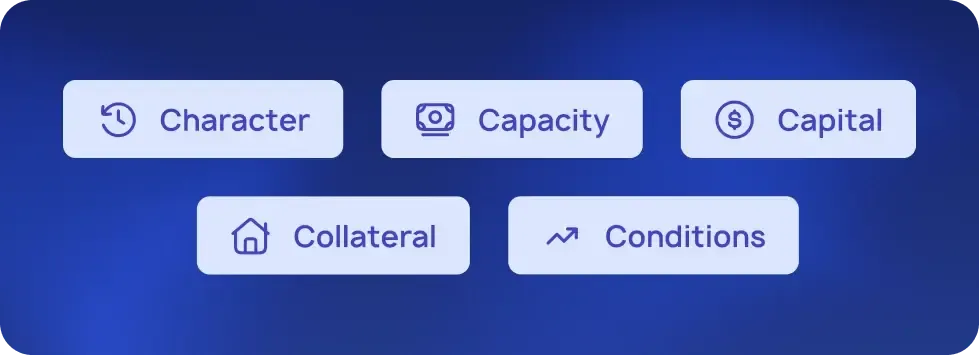
The five Cs of credit are a longstanding framework lenders use to evaluate the overall risk of extending credit. Rather than relying on a single score or financial metric, the framework considers five complementary dimensions of borrower and market risk.
- Character: A borrower's history of managing financial obligations.
- Capacity: The borrower's ability to repay based on income and cash flow.
- Capital: The financial resources a borrower already has invested or available.
- Collateral: Assets that can secure the loan if repayment does not occur.
- Conditions: External economic, market, and loan-specific factors that influence lending risk.
While every institution weighs these factors differently depending on product type and risk strategy, the five Cs remain one of the most widely recognized approaches to credit evaluation.
Character in the age of AI
Character isn't about personality or whether someone seems trustworthy during a job interview. For credit providers, character refers to a borrower’s trustworthiness and how likely they are to repay a loan.
Several factors commonly shape assessments of character when it comes to credit underwriting:
- Traditional creditworthiness metrics. Payment history, account age, credit utilization, and previous borrowing behavior continue to provide valuable insight into how borrowers have managed credit over time.
- Clear identification. Before evaluating risk, lenders must verify that applicants are who they claim to be. Identity verification, fraud detection, and authentication tools help reduce losses while supporting compliance requirements.
- Behavioral financial signals. With borrower permission, cash flow patterns, account activity, and recurring payment behavior can provide additional context that traditional bureau data may not capture, particularly for borrowers with limited credit histories.
Character remains one of the strongest predictors of repayment, but the way it's measured has become far more sophisticated. Modern underwriting platforms combine traditional credit bureau data with alternative financial signals, AI-assisted risk models, and automated identity verification to create a more complete assessment of borrower reliability. These technologies allow lenders to evaluate character with greater confidence and consistency.
Capacity in the age of AI
Capacity measures whether a borrower can realistically repay new debt based on their current financial situation. Unlike character, which looks primarily at past behavior, capacity focuses on present and future ability to make payments.
Historically, verifying capacity often required collecting and reviewing documents manually. Today, much of that process can be automated. Several considerations contribute to capacity:
- Income verification. Employment and income remain foundational, but automated verification services increasingly replace manual collection of pay stubs and tax documents.
- Cash flow. Open banking and consumer-permissioned financial data allow lenders to evaluate income, spending, and recurring obligations using current account activity rather than a single snapshot in time.
- Existing debt obligations. Debt-to-income ratios and other affordability measures help determine whether borrowers can comfortably take on additional credit.
- Future capacity. Credit providers may also consider how a borrower’s capacity will evolve over the course of the credit product.
Modern lending platforms allow credit providers to evaluate repayment capacity using real-time financial information instead of relying solely on historical documentation. Combined with automation and AI-assisted decisioning, these capabilities help lenders reach faster, more accurate decisions while reducing application friction.
Capital in the age of AI
Capital refers to the financial resources borrowers already have available. Savings, investment accounts, retained earnings, or other assets demonstrate a borrower's financial resilience and ability to weather unexpected expenses.
While capital has always been part of many underwriting models, verifying those resources has traditionally required significant manual effort. Lenders typically evaluate several aspects of capital:
- Available assets. Cash reserves, savings, and investment accounts can demonstrate financial stability beyond regular income.
- Source of funds. Verifying where assets originate helps lenders satisfy compliance requirements while confirming that reported resources are legitimate and accessible.
- Borrower investment. For many lending products, the amount borrowers contribute themselves provides additional insight into both financial strength and commitment.
Modern verification tools allow lenders to confirm assets directly through connected financial institutions instead of relying exclusively on uploaded statements. AI can also help identify inconsistencies, surface exceptions for review, and automate routine verification tasks, allowing underwriting teams to focus their attention where it's needed most.
Collateral in the age of AI
Collateral consists of assets that secure a loan and help reduce lending risk. While homes and vehicles are among the most common examples, many asset types can serve as collateral depending on the credit product.
Collateral affects underwriting in several important ways:
- Asset value. Lenders must determine whether collateral provides sufficient value to support the requested loan.
- Ownership and lien position. Existing liens, title status, and ownership records all influence the level of protection collateral actually provides.
- Recoverability. Different asset types carry different recovery costs, legal requirements, and resale considerations, all of which factor into underwriting decisions.
Collateral management has become increasingly data driven. Automated valuation models, integrated property and vehicle data, and AI-assisted risk analysis allow lenders to assess collateral more quickly while maintaining appropriate controls. Modern lending platforms can also integrate collateral information directly into underwriting and servicing workflows, creating greater consistency throughout the loan lifecycle.
Conditions in the age of AI
Conditions refer to the external factors that influence lending risk but fall outside the borrower's direct control. Economic trends, industry performance, interest rates, regional markets, and even the intended purpose of the loan can all affect a lending decision.
Lenders often evaluate conditions by considering:
- Macroeconomic trends. Inflation, unemployment, and interest rate changes can affect both borrower performance and portfolio risk.
- Industry and regional factors. Certain markets or industries may experience changing risk profiles based on local or sector-specific conditions.
- Loan purpose. The intended use of funds often influences underwriting criteria and expected repayment risk.
Conditions change constantly, and modern underwriting systems make it easier to respond as they do. Rather than updating lending policies only periodically, configurable decision engines, real-time data feeds, and AI-assisted analytics allow credit providers to adjust underwriting strategies as market conditions evolve. The result is a lending operation that remains both responsive and consistent without abandoning the proven framework of the five Cs.
Why the 5 Cs still matter
The five Cs have remained relevant for decades because they ask the fundamental questions every lender still needs to answer:
- Can this borrower be trusted to repay?
- Can they realistically afford the loan?
- Do they have financial resources beyond their income?
- Is there collateral to reduce risk?
- What external factors could affect repayment?
Today's lending platforms combine automation, AI, open banking, and real-time verification to give credit providers a clearer picture of every application. Modern technology makes it possible to evaluate each of the 5 Cs more accurately, more consistently, and at far greater scale.
Modernize underwriting without abandoning proven lending principles. LoanPro helps credit providers build flexible lending operations that support automated decisioning, configurable workflows, and modern servicing across the entire loan lifecycle.
Learn how LoanPro powers modern lending.
Have questions? Checkout our FAQ:
What’s the difference between the 3 c’s and 5 c’s if credit?
The three Cs — character, capacity, and collateral — focus on core borrower risk. The five Cs expand the framework by adding capital and conditions, giving lenders a more comprehensive view of both the borrower's financial position and the broader economic environment that may affect repayment.
How do lenders use AI when evaluating credit applications?
AI supports underwriting by helping analyze larger volumes of financial data, identifying patterns that may indicate risk, automating verification processes, and improving consistency across lending decisions. Most lenders use AI alongside traditional underwriting policies rather than as a replacement for human oversight.
Can AI replace the 5 Cs of credit?
No. AI doesn't replace the five Cs. It helps lenders evaluate them more effectively. AI can analyze larger data sets, automate verification, identify patterns, and improve consistency, but the underlying principles of character, capacity, capital, collateral, and conditions remain central to responsible underwriting.
Are the five Cs still relevant for modern lending?
Yes. While the technologies used during underwriting have evolved significantly, the five Cs remain a widely used framework for evaluating credit risk. Modern lending platforms simply provide better data and more efficient tools for assessing each factor.
Do all lenders use the 5 Cs of credit?
Not necessarily. Some lenders explicitly use the five Cs as an underwriting framework, while others rely on proprietary scoring models or AI-assisted decision engines. Even when the terminology differs, many modern underwriting models evaluate the same underlying factors represented by the five Cs.
What's the difference between a credit score and the 5 Cs?
A credit score is one input into the underwriting process. The five Cs provide a broader framework that considers not only credit history, but also repayment ability, available assets, collateral, and external economic conditions.