What is ACH? And why bank transfer delays cost lenders conversions
The foundation of every economy and business is the ability to move money efficiently and securely. The Automated Clearing House (ACH) network facilitates billions of payments and money transfers each year across the United States, including loan disbursements and payments.
While ACH transfers are more secure than paper checks, using ACH for loans can be too slow to meet today’s consumer expectations for fast, efficient access to funds.
This is your definitive guide on ACH payments for modern lenders, including all of the fundamentals of ACH and how to solve for its critical limitation in the lending lifecycle: funding delays that cost you customers and revenue.
In this guide, we cover:
- What is an ACH payment?
- Key terms: ACH, Nacha, direct deposit, direct payment, and more
- How do ACH transfers work in the loan lifecycle?
- ACH credits vs. debits: From disbursement to repayment
- ACH vs. wire vs. RTP: Choosing the right rail for the job
- The strengths of ACH for lending operations
- Faster access to funds than paper checks
- Low-cost transactions for higher margins
- Improved security and reduced fraud risk
- High reliability for recurring loan payments
- The critical limitation: Why ACH delays cost conversions for lenders
- Failing to meet modern borrower expectations for speed
- The business cost of loan approval 'fallout'
- The innovation bridge: Moving beyond ACH for loan disbursement
- Sneak peek: Loan on Card
What is an ACH payment?
ACH payments are electronic money transfers between bank accounts processed through Nacha, the National Automated Clearing House Network.
ACH is a foundational, modern payment processing system for moving money in the United States. In fact, Nacha reported that the modern ACH Network safely and efficiently processed 33.6 billion payments in 2024 valued at $86.2 trillion.
However, ACH is not a perfect system when it comes to funding loans. For modern lenders who need to fund loans quickly, the process can be too slow — taking days to deliver funds to borrowers.
Key terms: ACH, Nacha, direct deposit, direct payment, and more
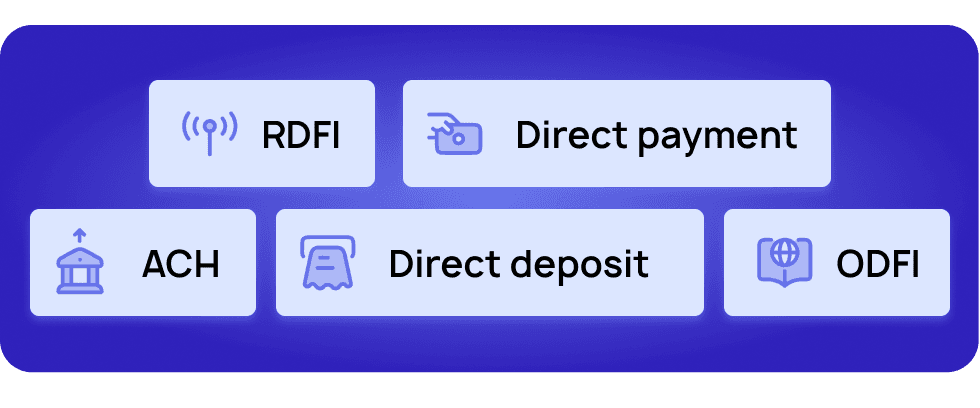
ACH: The Automated Clearing House Network is an electronic network for financial transactions, used by banks to process and settle payments. It enables direct deposits, such as employee payroll and loan disbursements, and direct debits for recurring bills like utilities or mortgages.
Nacha: The National Automated Clearing House is a U.S. nonprofit organization that develops and enforces the rules for the ACH Network, the payment system that drives direct deposits and payments between U.S. bank and credit union accounts.
Direct deposit: Direct deposits, sometimes referred to as ACH credits, is when money is deposited into a financial account.
Direct payment: Direct payments, sometimes called ACH debits, is when money is taken from an account.
Originating depository financial institution (ODFI): An ODFI is the bank or credit union that originates an ACH transaction and sends it to the network.
Receiving depository financial institution (RDFI): An RDFI is the bank or credit union that receives the ACH transaction and posts it to the person’s account.
How do ACH transfers work in the loan lifecycle?
Lenders use ACH transfers throughout the loan lifecycle to electronically disburse funds to borrowers, as well as receive payments back from consumers and businesses to repay the loans.
ACH credits vs. debits: From disbursement to repayment
The ACH Network can be used at every step of the loan lifecycle, from disbursement to repayment:
Disbursing loans: During disbursement, lenders use an ACH credit, or direct deposit, to send loan funds to a borrower's bank account. This is faster than writing and mailing a paper check.
Receiving repayments: For repayment, lenders use a direct payment, or ACH debit, to pull an agreed-upon amount from a borrower’s account. The borrower authorizes these withdrawals on a set schedule as part of the loan agreement. These ACH debits automate the repayment process, saving time for borrowers and ensuring timely payments.
ACH vs. wire vs. RTP: Choosing the right rail for the job
ACH transfers are not the only kind of electronic fund transfers (EFTs) that can be used to fund or repay a loan. Other types of EFTs include Real-Time Payments (RTP), wire transfers, or even credit card transactions.
As lenders consider different payment rails, it’s important to understand the trade-offs involved with each type.
Real-Time Payments offer a nearly instant option for transferring funds. But, once money is sent via RTP, it cannot be canceled or reversed, making the risk of fraud higher. In addition, some RTP systems may use less secure authentication processes that could be compromised.
Similarly, wire transfers are usually processed the same day, which also creates higher risk of fraud as the transfer can’t be stopped once funds are received. Wire transfers are also significantly more expensive, with fees starting at $10 per wire transfer. This is why ACH transfers became the standard for payments and loan disbursements since most ACH transfers are free.
Today, most loan lenders don’t offer the option to repay loans by credit cards because of costs associated with it. However, new innovations are on the horizon to issue credit cards as loan disbursements (see our sneak peek at the end of this guide). Credit cards can provide the speed and security modern lenders and borrowers want, without waiting the days it may take for ACH transfers to process.
The strengths of ACH for lending operations
Leveraging the widely-used ACH Network for lending operations offers a number of benefits for both lenders and borrowers.
Faster access to funds than paper checks
Instead of waiting days or weeks for paper checks to arrive in the mail, ACH payments can be processed in just 1-3 days, with some ACH credits available on the same day. ACH also eliminates any delays caused by manual processing or mail carrier issues.
Low-cost transactions for higher margins
ACH transactions can be significantly more cost efficient than other methods like wire transfers. The ACH Network uses a flat-rate or small percentage fee and has less administrative overhead than paper checks that require manual processing. This allows lenders to disburse loans efficiently while retaining a larger portion of the loan value.
Predictable cash flow: Electronic transfers ensure funds are received on a specific date, making financial forecasting more reliable for both the lender and the borrower.
Improved security and reduced fraud risk
Electronic fund transfers are more secure than paper checks that can be stolen or altered in transit. In addition, Nacha has created clear standards that create multiple layers of security including multi-factor authentication, data encryption, and required verification methods for account validation and routing numbers as part of ODFI fraud detection systems.
High reliability for recurring loan payments
ACH enables borrowers to set up recurring, automated payments, creating a more predictable cash flow for lenders. This automated repayment also ensures more timely payments without the need for any manual work by the borrower.
Improved borrower experience
Using ACH to fund and repay loans also creates a more streamlined experience for borrowers. Instead of eagerly checking the mailbox, borrowers get funds delivered straight to their bank account. Instead of manually paying the bill each month, borrowers can set up automated repayments.
The critical limitation: Why ACH delays cost conversions for lenders
Even with all the benefits that ACH offers for lenders and borrowers, there is still room for improvement.
Because the ACH Network uses batch processing at different intervals throughout the day, it can take up to five business days to deliver funds to a borrower. ACH transfers are also only processed on business days, meaning weekends and holidays could also delay funds.
Speed is now one of the top factors borrowers evaluate when choosing a loan provider. If it takes too long to receive the funds they need, consumers and businesses will turn elsewhere.
Failing to meet modern borrower expectations for speed
In the same way that borrowers want instant loan approvals, they want instant access to their loan funds. In fact, according to PYMNTS Intelligence data, 64% of consumers want instant funding for loans — with more than one in four say they require the funds in 30 minutes or less.
For many consumers and businesses, fast access to loan funds isn’t just nice to have. It’s a must in their financial lives. This is why payday loans and Buy Now, Pay Later options are attractive to many.
In the same way that people can now order groceries, dinner, and more with a few clicks on a mobile app, they expect to be able to complete a loan application and access approved funds quickly and easily.
The business cost of loan approval 'fallout'
When loan processing takes too long, a lender’s bottom line gets hit with both lost revenue and sunk operational costs. Lending operations that are too slow or too cumbersome also hurt a lender’s reputation, preventing customers from coming back to them next time they need a loan.
On the flip side, if loans have a positive user experience — easy to apply, quick access to funds, and automated repayment options, borrowers are likely to borrow again and again.
The innovation bridge: Moving beyond ACH for loan disbursement
Lenders need a modern loan experience that enables the provisioning of instant funds while maintaining complete control over the loan experience. The answer? Mobile wallets and card-based access.
Today, more than 4.8 billion users leverage the convenience of mobile wallets to make payments on everyday purchases. Why should loans be any different? By leveraging a loan with card-based access, lenders can skip ACH batch processing and deliver funds faster to borrowers.
The next generation of loan disbursement: Loan on Card
The future lies in what LoanPro calls Loan on Card, which will combine the structure of a consumer installment loan with the convenience of a credit card. (Request a sneak peek of this new solution today)
Instead of using ACH, funds will soon be able to be disbursed to a card issued through your chosen issuer processor and provisioned instantly to a borrower’s mobile wallet — or even an optional physical card.
It’s not a revolving credit card, but a loan with card-based access. Lenders control the loan terms and the experience, while customers get immediate spending power. The benefits are clear:
- Lenders maintain full control over the lending experience while simplifying point of sale (POS) distribution and deepening relationships with a modern card experience.
- Consumers gain instant access to loan funds through their digital wallet, clear and predictable repayment terms, and can pay anywhere Mastercard is accepted.
Tired of ACH delays? Get instant access with Loan on Card.
Download LoanPro’s exclusive Loan on Card Overview to learn how to launch a modern loan experience with instant funds provision, card-based access, and predictable repayment.