What is a webhook? A simple guide to webhook integration
If you've scrolled through any sort of social media lately, chances are you've been served an ad about a software solution that will revolutionize the way you do business and increase ROI. We're not here to speculate on the accuracy of said claim, but if you didn't like that one, you probably scrolled by another SaaS ad a few swipes of your finger later. The SaaS industry has been growing at a blistering pace—the global SaaS market reached $390.5 billion in 2024 and is projected to hit $793 billion by 2029.
SaaS is here to stay and has indeed changed the way that companies conduct business. In fact, as of 2024, companies use an average of 106 SaaS applications each, and 85% of all business software is expected to be SaaS-based by the end of 2025. With so much SaaS being introduced into business' operations, it's more important than ever to find a way to connect these systems together to promote unity, increase automation, and decrease time spent switching between tabs and windows on your PC. Lenders for example may want to connect their lending platform to Slack or another communication platform, and automatically send servicing managers a message when an account is 10 days past due. This can be done simply with a webhook platform compatible with financial services apps.
What is a Webhook?
A webhook (sometimes called an API webhook) is a callback function that allows event-driven communication between two applications. In other words, webhooks are used to send information from one application to another whenever certain criteria are met within the sending application. This is a huge upgrade over another common method of receiving data called polling, in which a manual API call was made from the sending system to another system, asking if any new data was available. This process was burdensome. Manual processes aside, there was no guarantee that any new information was even available.
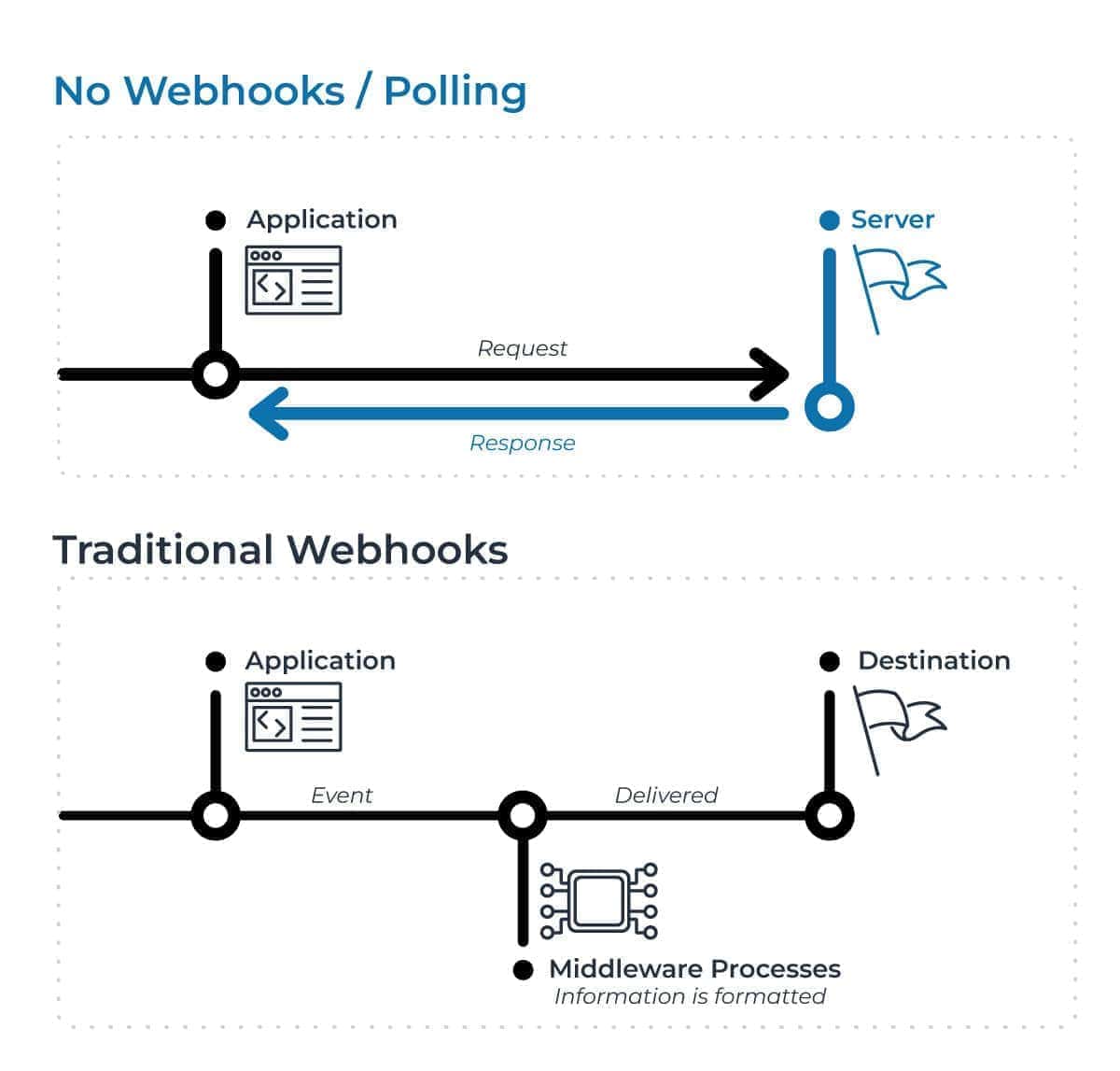
Webhooks are a much better option than polling
Webhooks solved this problem. Making a call only when certain criteria were met meant that your data was always ready.
The problem with traditional webhooks is how information in the payload (the content of your request) is formatted. Most systems don’t speak the same language. Imagine trying to ask somebody who only speaks Korean for a very specific and detailed favor, as an English speaker. The application sending the webhook needs to be formatted in a way that when the receiving application gets the data, it can read it and know what to do with it. This is usually done by purchasing outside software like middleware. Alternatively, you could spend $100k or so hiring an in-house dev team, or lose control and resources by outsourcing it to a third party.
It's tricky to integrate systems with webhook integration, whether you're using a homegrown system or trying to determine the software which is most beneficial to your company, not all integrations are created equal. A lot of systems restrict webhooks integrations to a very specific or predefined set of rules. Other systems will require the use of middleware to even make a webhook work.
Webhook vs API: Understanding the difference
While both webhooks and APIs enable communication between applications, they work differently:
APIs (Application Programming Interfaces) require your system to continuously ask, "Is there new data?" This polling approach means making repeated requests whether new information exists or not, consuming resources and creating delays.
Webhooks, on the other hand, automatically push data to your application the moment an event occurs. Instead of constantly checking for updates, your system receives real-time notifications only when something actually happens. This event-driven approach is faster, more efficient, and reduces unnecessary API calls.
Think of it this way: APIs are like running a daily batch report to see which accounts went delinquent. Premium webhooks are like having your collections team instantly alerted the moment an account hits 30 days past due.
Greater Connectivity with LoanPro’s Premium Webhooks
Have no fear, an easier way to maintain control and connect your application without the need for costly middleware or dedicated dev teams is here. LoanPro's webhook platform is designed specifically for financial services applications, making premium webhooks accessible without technical complexity. We have solved the issue of developing a way to send information, and in most cases, without the need for outside development. With LoanPro’s premium webhooks you can:
- Eliminate the complexity of configuring messages between multiple systems
- Send HTTP request methods (GET, PUT, POST, DELETE) in whichever format you’d like
- Add any variables to the payload that you please, as well as format the payload information within LoanPro’s UI
- Gain real-time updates between systems for a consistent customer and back-office experience
- Improve customer experience with live loan updates
- Automate time-consuming manual processes downstream
The main differentiator for LoanPro’s premium webhooks is the ability to customize every part of your webhook with no dev team, and without ever leaving LoanPro’s UI, this includes:
- Headers – Who is sending the information? Headers are used to authenticate the sender and determine if the information is coming from a reliable source.
- Method – This states the desired action to be performed. In LoanPro users have access to GET (retrieve data) PUT (update existing data) POST (create new data) and DELETE (remove data) methods.
- Payload/Body – The payload or body is the content of your request. Generally, requests that add or update content will include a payload, but requests to retrieve or delete information will not.
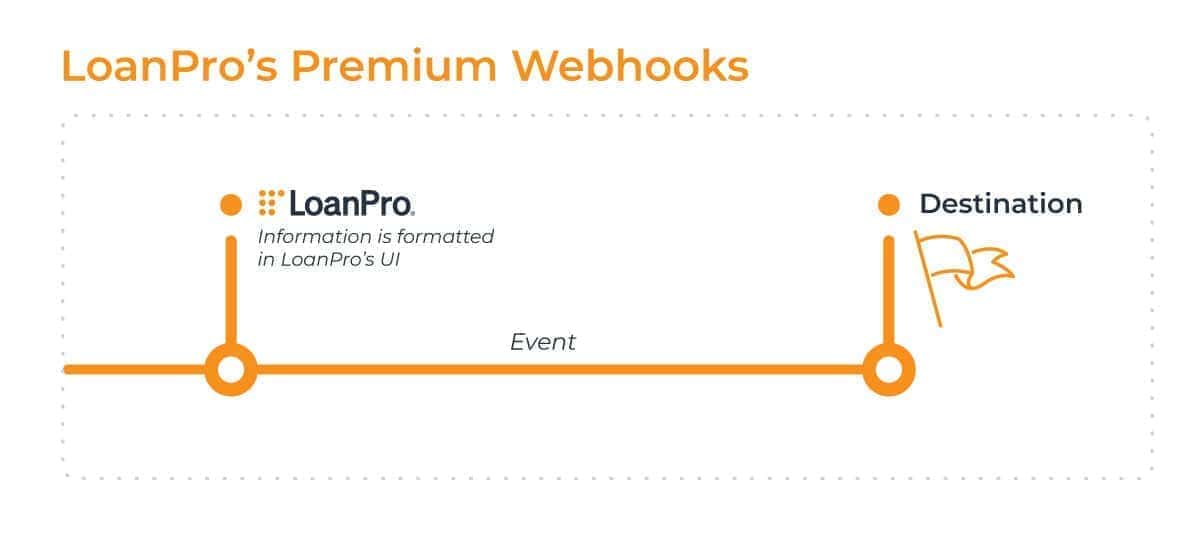
LoanPro’s webhooks provide greater connectivity
LoanPro’s premium webhooks eliminate the complexity of configuring messages between multiple systems allowing for the seamless transfer of data between systems. Access to all these customization options means unlimited automation and a substantial amount of money saved on middleware and development.
Webhook Examples
Before we jump into some examples of how we’ve seen clients utilize our premium webhooks, keep in mind a lot of these functions (accounting, reporting, messaging) are able to be done natively within LoanPro with our robust set of lending tools, and integrations with many leading softwares. Suppose you have pre-existing processes that involve niche or homegrown software that you’d like to continue using. In that case, the majority of the time, premium webhooks offer a great way for LoanPro to connect to them.
Now that we’ve hyped them up, let’s temper expectations, premium webhooks are not an “end all be all” solution. Some of the more complex processes may still require middleware to an extent, but our premium webhooks are an effective solution for the majority of connectivity complications that we see lenders face.
Let’s look at some of the ways we have seen lenders who use LoanPro utilize our premium webhooks to automate tasks both in and outside of LoanPro.
- Update user information in a homegrown CRM to replicate changes made to the same user inside of LoanPro.
- Communicate with external tax services to stay compliant with state & country tax regulations and keep the tax amounts updated in LoanPro.
- Use autopay webhooks to create auto pays automatically for processes that would normally have added a separate step for an agent to add or edit.
- Log a note with the action that just took place to eliminate the need for an agent to take the time to log one. This increases efficiencies for collections agencies and reduces redundancies for servicing agents, leading to higher loan-to-agent ratios and lower spending for clients.
- Send numbers to accounting systems (discount accrual, escrow information, payment information, etc.)
- Recalculate payment schedules automatically and adjust future payments.
These are just a few examples of the automations possible for your business by using LoanPro’s premium webhooks. Simply put, the possibilities are endless and give lenders more flexibility than ever before.
Conclusion
Though traditional webhooks seemingly solved the issue of connecting multiple systems, LoanPro’s configurable Premium Webhooks are the easiest way to connect your applications now, while also future-proofing your business for when more apps inevitably come. The tool decreases the need for additional software just to reformat information, saving you time and money. Additionally, webhooks unlock powerful automations, such as the ability to log autopay adjustments or update borrower profiles without the need for manual input.
Overwhelmed about setting up a webhook for yourself? LoanPro prides itself on having the brightest lending and tech experts in the business and includes webhook set up as part of our support offering. Our people are specially trained to ensure your webhooks and automations are configured to your specific needs. To learn more about our premium webhooks as well as other features that streamline your lending operations, secure a demo with one of our platform experts.
Frequently Asked Questions About Webhooks
What is a webhook used for?
Webhooks are used to automatically send data from one application to another when specific events occur. Common uses include sending notifications when a payment is processed, updating customer records across multiple systems, triggering automated workflows, and syncing data between platforms in real-time. For lenders, webhooks can automate tasks like notifying servicing managers when accounts become past due or updating CRM systems when loan information changes.
Do webhooks require coding?
Traditional webhooks typically require developer resources to configure the payload format, authentication headers, and HTTP methods. However, LoanPro's premium webhooks eliminate this requirement. You can customize headers, methods (GET, PUT, POST, DELETE), and payload formatting entirely within LoanPro's UI without writing any code or hiring a development team.
What's the difference between polling and webhooks?
Polling requires your system to repeatedly ask another system "Is there new data?" at regular intervals, whether updates exist or not. Webhooks automatically push data to your application only when an event actually occurs. Webhooks are more efficient, faster, and reduce unnecessary API calls compared to polling.
Can webhooks work without middleware?
Most webhook systems require middleware to translate data formats between applications that don't "speak the same language." LoanPro's premium webhooks solve this problem by allowing you to configure the payload format directly in our UI, eliminating the need for costly middleware in most cases. While some complex integrations may still benefit from middleware, the majority of webhook integrations can be set up without it.