10 best commercial lending software providers in 2026

Commercial real estate and commercial and industrial (C&I) loans top the list of lending priorities for banks in 2026. Approximately 3 out of 4 banks cite these 2 loan types as their biggest lending priority, according to Cornerstone Advisors research report: What’s Going on in Commercial Lending.
But, here's the catch: banks may be prioritizing commercial lending, but they aren't rushing to modernize the technology behind it. Cornerstone reported just 10% of banks plan to replace or select a new commercial loan origination system (LOS) this year.
That makes choosing the right commercial lending software even more important. When commercial lending is a strategic priority, the technology supporting it can't be an afterthought.
A commercial loan might involve multiple borrowers or guarantors, complex repayment structures, multiple collateral types, variable rates, covenants, and ongoing monitoring long after the original underwriting decision. The software supporting that loan needs to handle those complexities without turning every exception into a manual workaround.
If you’ve already read our broader guide to the 10 best loan management software platforms in 2026, this is your commercial lending-specific companion. General loan management systems can support many types of lending, but commercial lenders often need deeper configurability, more sophisticated portfolio management, and stronger support for complex business lending structures.
This guide looks at 10 commercial lending platforms worth considering in 2026, with an emphasis on the capabilities that matter most to commercial lenders: origination, servicing, configurability, automation, portfolio management, integrations, and support for complex loan structures.
Key takeaways
- Commercial lending software needs to handle complexity beyond basic loan servicing. Look for support for varied loan structures, collateral, covenants, multiple parties, variable rates, and specialized payment rules.
- End-to-end platforms can reduce friction between origination and servicing. When loan data and workflows move cleanly from underwriting into servicing, lenders can reduce rekeying and operational handoffs.
- Configurability matters as much as functionality. Commercial lenders often need to adapt products, workflows, calculations, and policies without relying on extensive custom development.
- Enterprise commercial lending platforms and modern lending cores serve different needs. Large banks may prioritize syndication, corporate lending, and deep enterprise functionality, while fintechs and specialty lenders may prioritize API access, speed, and product flexibility.
- The best platform depends on your lending model. A lender focused on syndicated corporate loans will have different requirements from an SMB lender, private credit fund, equipment financier, or commercial real estate lender.
Quick comparison: Top commercial lending software
| Potential strongest fit | Standout capability | What to watch for | |
|---|---|---|---|
| LoanPro | Customized business lending and modern loan operations | Configurable lending core and flexible APIs for building differentiated products and workflows at speed and scale | Maximizing flexibility may require technical resources |
| nCino | Commercial banking modernization beyond lending | Commercial banking workflow integration | Broader platform may be more than lending-only buyers need |
| Finastra Loan IQ | Corporate and syndicated lending | Transaction management for complex, multiparty commercial lending | Enterprise implementation and operational complexity |
| FIS Commercial Loan Servicing | Large, high-volume commercial portfolios | Deep servicing and transaction processing for complex commercial portfolios | Enterprise-scale deployment may be excessive for smaller or less complex lenders |
| Abrigo | Smaller community and regional financial institutions that want to connect to a broader credit-risk ecosystem | Lending and credit risk capabilities | Less suited to lenders seeking a highly modular lending technology stack |
| Nortridge | Complex loan servicing and specialty lending programs | Product and servicing configurability | Commercial origination may require complementary technology |
| Baker Hill | Banks and credit unions primarily focused on commercial loan origination only | Credit analysis and financial spreading | Primarily an origination and credit workflow solution rather than an end-to-end servicing platform |
| TurnKey Lender | Digital-first lenders focused on automating commercial underwriting and lending workflows | Workflow and decisioning automation | Complex enterprise requirements need validation |
| LendFoundry | Fintechs expanding into business lending | Modular technology for business loan origination, underwriting, servicing, and collections | Lenders with highly complex commercial deal structures may need additional configuration or integration |
| Canopy | Collateral-intensive B2B lending use cases | Connecting loan, collateral, valuation, and LTV monitoring | Organizations needing a full traditional commercial LOS may need complementary technology |
Top 10 best commercial lending platforms in 2026
1. LoanPro
Best suited for customized business lending and modern loan operations
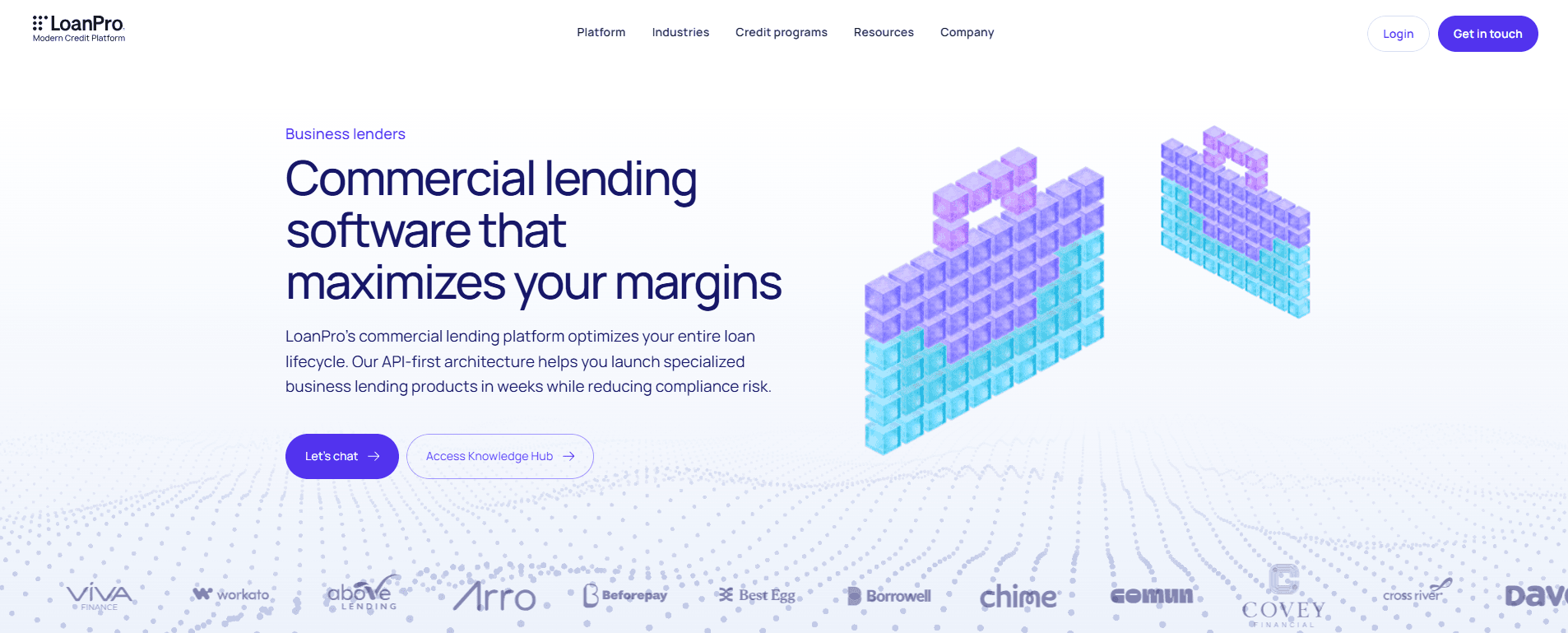
LoanPro is an API-first lending and credit platform designed to support the full loan lifecycle, from origination through servicing, payments, and collections. Its commercial lending capabilities are built around configurability, allowing lenders to create and manage a wide range of business lending products without being constrained by a rigid loan structure.
The platform supports business installment loans, lines of credit, equipment leases, merchant cash advances, business credit cards, and custom credit programs. It also provides commercial-specific functionality for areas such as receivables factoring, curtailment dates, collateral, interest reserves, and specialized payment structures.
Key strengths:
- API-first architecture designed for integration and extensibility
- Configurable origination and servicing on a unified platform
- Support for a broad range of commercial and specialty lending products
- Automation engine for business-specific workflows and servicing processes
- Integrated payments and collections capabilities
- Real-time ledger and configurable loan logic
What to consider: LoanPro's flexibility is a major advantage for lenders building differentiated products, but organizations should have the technical resources to take full advantage of its APIs, integrations, and configurable workflows. Lenders with highly specialized covenant-monitoring requirements or large syndicated lending portfolios should also evaluate which capabilities are native to the platform versus those that may require additional configuration or integration.
2. nCino
Best suited for commercial banking modernization beyond lending
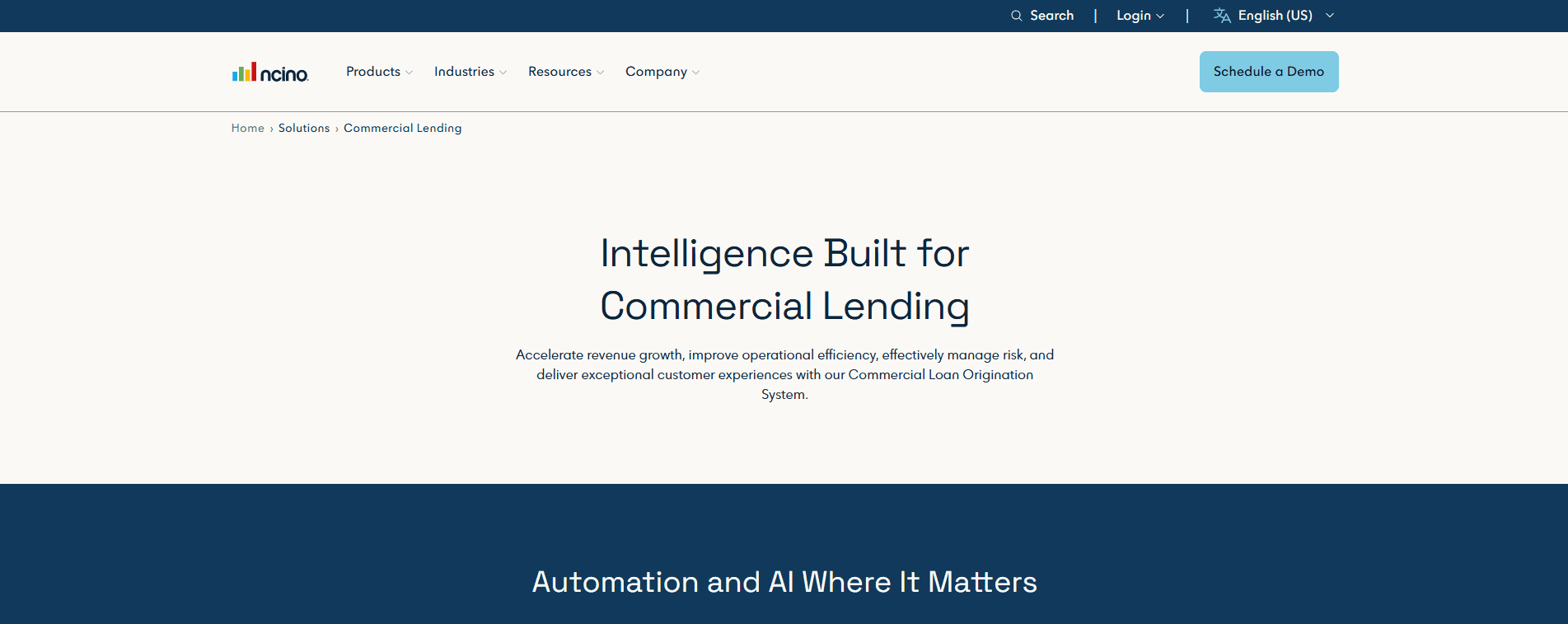
nCino brings commercial lending into a broader commercial banking platform, connecting origination and underwriting with customer onboarding and portfolio management. Its commercial lending capabilities include automated workflows, credit analysis and financial spreading, covenant notifications, and portfolio management.
The platform also has dedicated commercial real estate functionality, including NOI analysis, rent rolls, financial projections, sensitivity analysis, and portfolio monitoring.
Key strengths:
- End-to-end commercial banking and lending workflows
- Commercial loan origination and approval automation
- Financial spreading and credit analysis
- Covenant monitoring and notifications
- Commercial real estate analysis
What to consider: nCino's broad platform approach may be more than a lender needs if its primary goal is to modernize loan servicing or add a configurable lending core. Before selecting it, evaluate implementation requirements and how its commercial lending capabilities fit with your existing core, CRM, and broader banking technology stack.
3. Finastra (Loan IQ)
Best suited for corporate and syndicated lending

Finastra Loan IQ is built around large-scale commercial and corporate lending, with functionality spanning bilateral loans, syndicated transactions, specialty lending, and private credit. Finastra says Loan IQ is used by 21 of the 25 largest syndicated lenders and supports lending ranging from SME and bilateral loans to complex syndicated transactions, CRE, SBA, export finance, and private credit.
The platform centralizes commercial loan servicing and portfolio management, with a particular emphasis on automation, transaction processing, and control across complex lending operations.
Key strengths:
- Deep functionality for corporate and syndicated lending
- Support for complex loan structures and multiparty transactions
- Centralized commercial loan servicing
- Strong portfolio and transaction processing capabilities
- Support for private credit and specialty lending
- Enterprise-scale deployment options
What to consider: Loan IQ's enterprise orientation makes it a natural fit for large, sophisticated lending organizations, but that breadth can bring significant implementation and operational complexity. Smaller institutions and lenders with less complex portfolios should weigh whether the platform's extensive functionality justifies that investment.
4. FIS Commercial Loan Servicing
Best suited for large, high-volume commercial portfolios
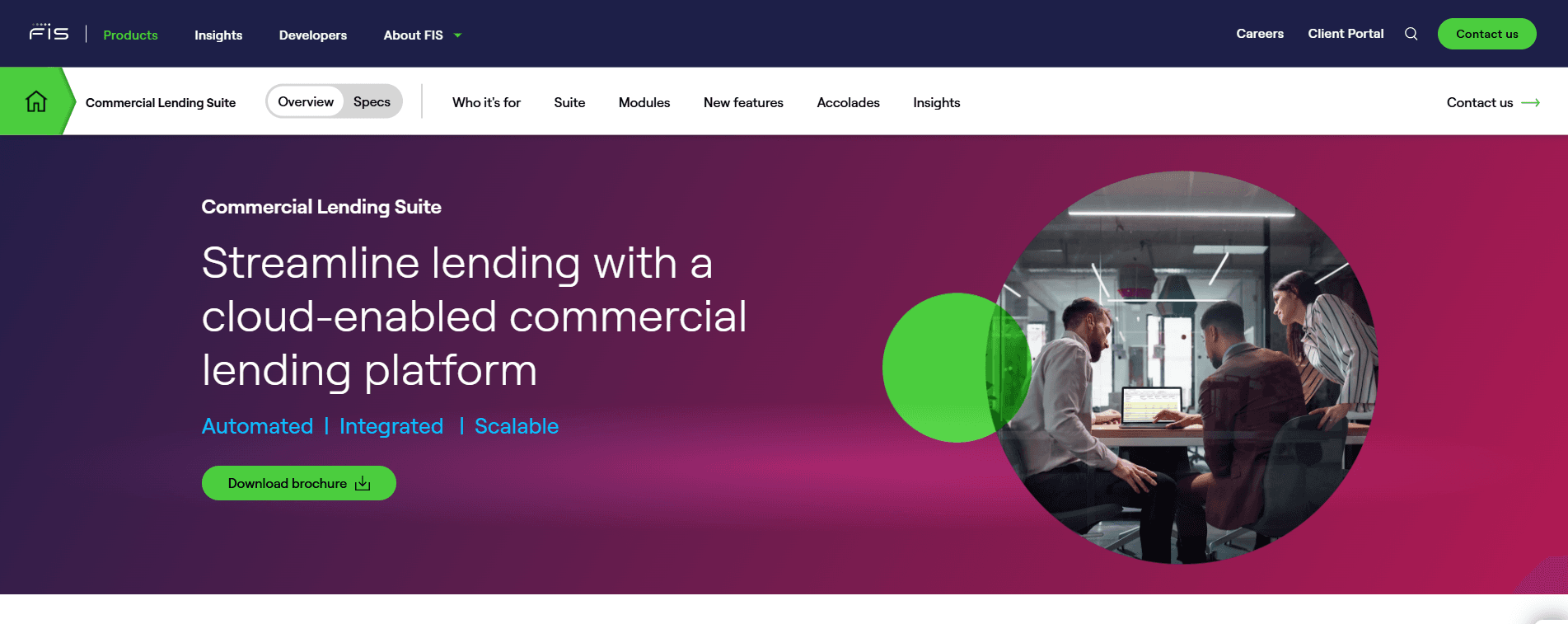
FIS Commercial Loan Servicing, formerly known as ACBS, is designed to manage commercial loans across the lifecycle, with functionality spanning deal creation, servicing, transaction processing, risk management, and portfolio operations. The platform is built to integrate loan and facility information from origination into servicing, reducing duplicate data entry during onboarding.
Its broader Commercial Lending Suite also includes portfolio management, risk analytics, industry-specific spreading, and digital capabilities.
Key strengths:
- Enterprise commercial loan servicing
- Covenant and obligation monitoring
- Portfolio-level analysis and risk management
- Complex transaction and accrual processing
- Enterprise reporting and compliance controls
- API and event-streaming capabilities
What to consider: FIS's breadth and depth are strengths for lenders managing complex commercial portfolios, but they also make implementation and integration important considerations. Evaluate the platform against your portfolio size, existing technology environment, and appetite for enterprise-scale modernization.
5. Abrigo
Best suited for community and regional financial institutions that want to connect to a broader credit-risk ecosystem
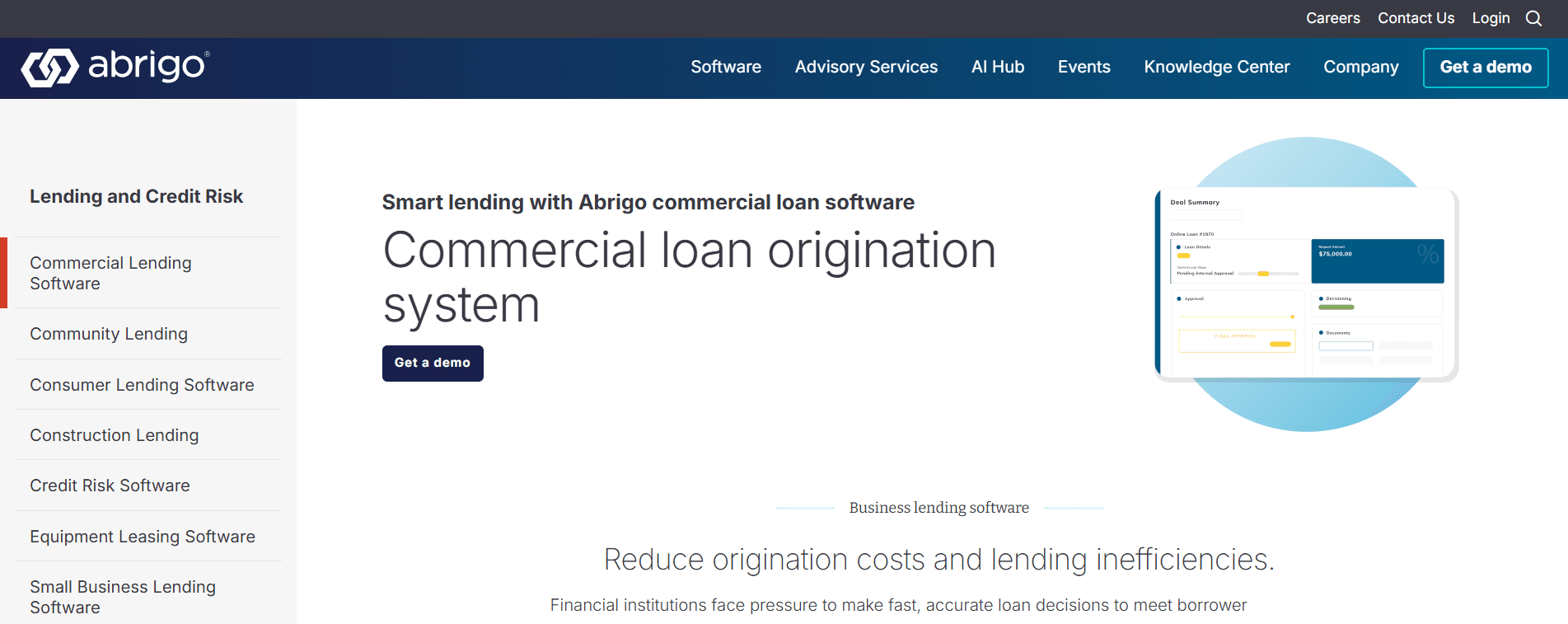
Abrigo's lending platform is designed for banks and credit unions, bringing commercial, small business, construction, consumer, and other lending workflows into a broader lending and credit-risk ecosystem. Its commercial lending capabilities include digital applications, workflow management, credit analysis, automated decisioning, relationship management, and portfolio insights.
Key strengths:
- Commercial loan origination
- Credit analysis and risk management
- Workflow and policy automation
- Small business and construction lending
- Relationship management
- Portfolio monitoring
What to consider: Abrigo's integrated approach can be valuable for financial institutions that want lending and credit risk capabilities within a broader technology ecosystem. Lenders that prefer a more modular architecture should compare how that approach affects integrations, customization, and the ability to select individual components of their lending stack.
6. Nortridge
Best suited for complex loan servicing and specialty lending programs

Nortridge provides configurable loan management and servicing software for commercial, real estate, consumer, auto, and other lending markets. Its strength is flexibility at the servicing layer, with support for complex loan structures, participations, syndications, variable rates, custom payment structures, collateral, fees, escrow, reporting, and audit trails.
Key strengths:
- Highly configurable loan products and workflows
- Support for participations and syndications
- Detailed collateral tracking
- Variable rates and custom payment structures
- Integrated collections
- Configurable reporting and analytics
- Credit bureau integrations
- API and data-access capabilities
What to consider: Nortridge's flexibility is concentrated primarily in loan management and servicing rather than the full commercial lending lifecycle. Organizations looking for integrated commercial origination, underwriting, and servicing may need additional systems to fill those gaps, which can increase implementation complexity and create more technology handoffs.
7. Baker Hill
Best suited for banks and credit unions primarily focused on commercial loan origination
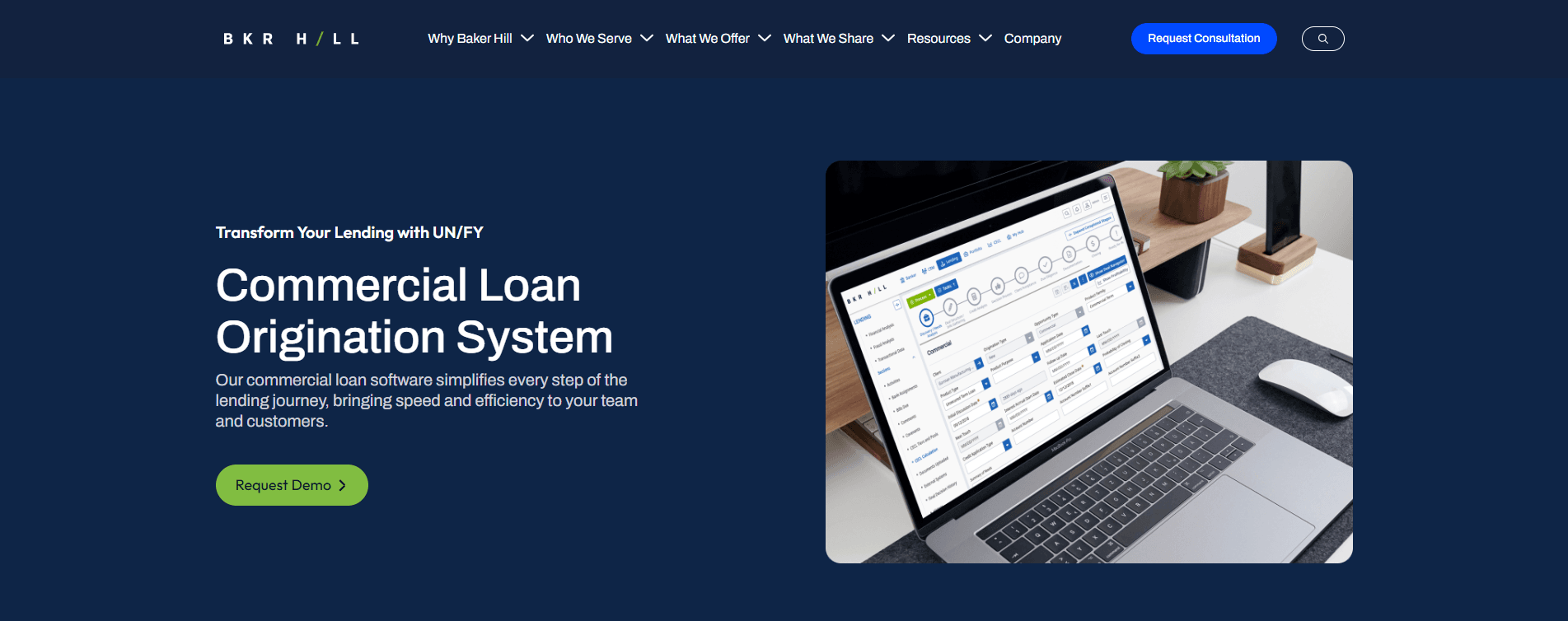
Baker Hill focuses on the front end of commercial lending, helping financial institutions manage deal structuring, financial analysis, credit documentation, approvals, and exceptions. Its commercial lending software includes statement spreading, cash-flow analysis, covenant information, credit memos, and exception tracking.
Key strengths:
- Commercial loan origination
- Unified deal and document management
- Automated financial statement spreading
- Deal structuring and exception tracking
- Configurable workflows
What to consider: Baker Hill is strongest on the origination and credit-analysis side of commercial lending, so lenders looking for a single platform across origination and servicing should evaluate the surrounding technology stack carefully. Consider how it will integrate with your servicing platform and where loan data will be handed off between systems.
8. TurnKey Lender
Best suited for digital-first lenders focused on automating commercial underwriting and lending workflows
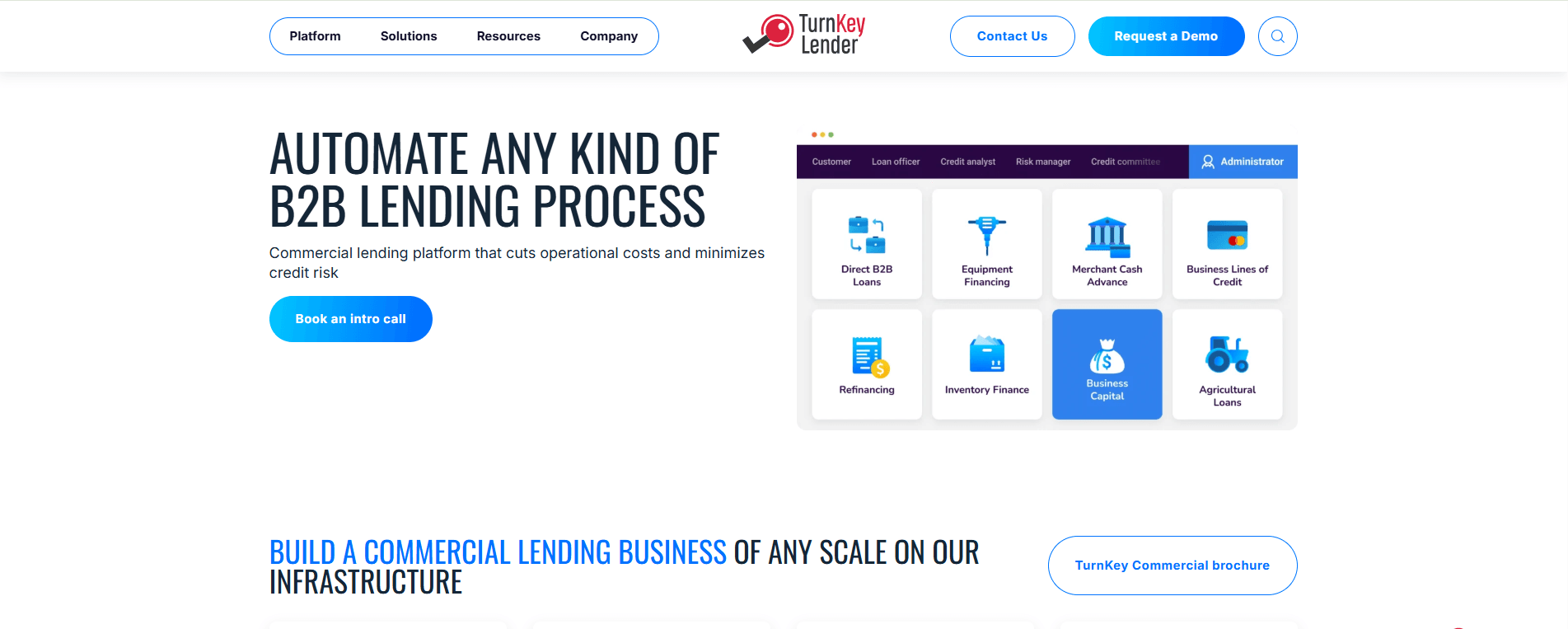
TurnKey Lender provides an end-to-end lending platform spanning applications, origination, underwriting, loan management, collections, and reporting. Its approach emphasizes configurable workflows and automated credit decisioning, making it relevant for lenders looking to digitize and streamline commercial lending processes.
Key strengths:
- Digital commercial loan origination
- Automated underwriting and decisioning
- Configurable commercial credit products
- End-to-end loan management
- Collections automation
- Reporting and analytics
- Broad integration ecosystem
What to consider: TurnKey Lender's emphasis on automation and configurable workflows can be valuable for digital-first lenders, but highly specialized commercial products may require additional configuration or integration. Lenders with complex enterprise environments should also evaluate how the platform fits with existing systems and governance requirements.
9. LendFoundry
Best suited for fintechs expanding into business lending
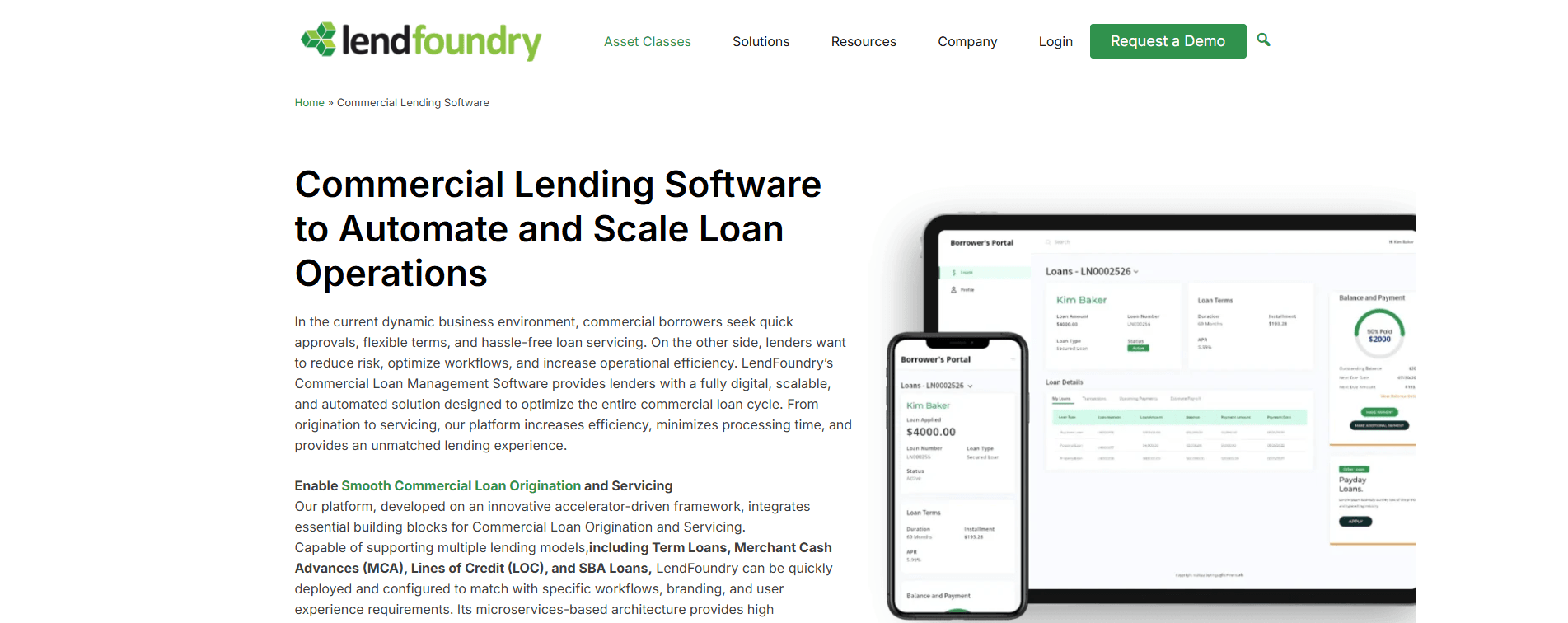
LendFoundry's commercial lending software is designed to automate the commercial loan lifecycle from origination through servicing. The platform supports term loans, lines of credit, merchant cash advances, and SBA loans, with configurable workflows and an API-based architecture.
Its capabilities include business application and lead management, business identity verification, credit and fraud checks, automated and manual underwriting, document management, funding, task management, audit trails, collections, and portfolio workflows.
Key strengths:
- Commercial loan origination and servicing
- Support for multiple business lending models
- Configurable underwriting rules
- API-first, microservices-based architecture
- Digital document management
- Workflow and task automation
- Collections and delinquency automation
What to consider: LendFoundry's API-based architecture can give digital lenders flexibility as their products and technology stack evolve, but that approach also puts more emphasis on integration and implementation. Lenders with complex commercial products should validate how the platform handles their specific deal structures and servicing requirements.
10. Canopy
Best suited for collateral-intensive B2B lending use cases
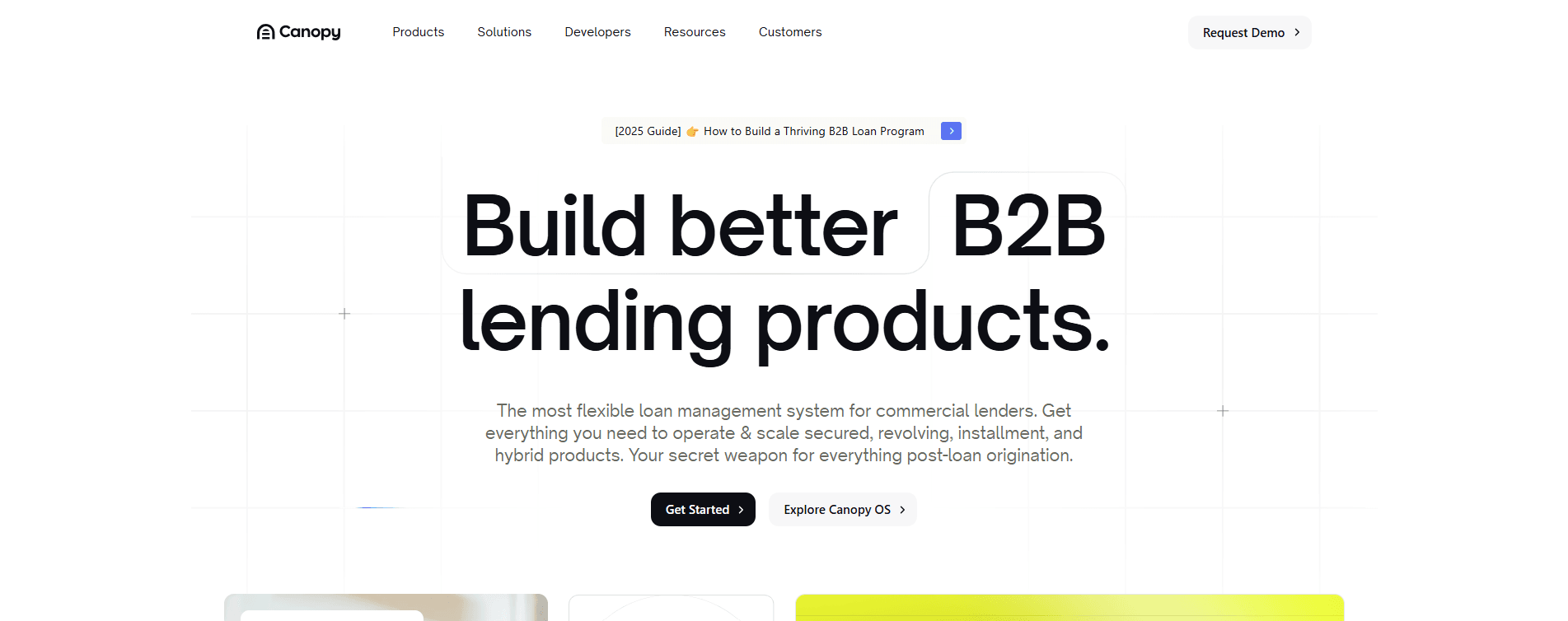
Canopy is a modern lending core focused on B2B lending, with support for secured, revolving, installment, and hybrid products. Its approach centers on configurable lending policies, automated workflows, real-time data, and a centralized system of record.
Key strengths:
- Purpose-built focus on B2B and commercial lending
- Flexible product and policy configuration
- Support for revolving, installment, and hybrid products
- Collateral management and LTV monitoring
- Workflow automation
- Real-time, immutable ledger
- API-based integrations
What to consider: Canopy's lending-core approach makes it a compelling option for lenders that want modern B2B servicing and configurable lending infrastructure. Organizations seeking a full commercial LOS or deeply integrated enterprise banking suite should evaluate which capabilities will come from Canopy and which will require complementary systems.
What to look for in commercial lending software
Commercial lending comes with more complexity than a standard consumer loan. When evaluating platforms, focus on whether the technology can support that complexity without creating more manual work.
- Commercial loan types: Look for support for the products you offer, including C&I, CRE, SBA, equipment financing, asset-based lending, and lines of credit.
- Origination and servicing: Consider whether you want one platform for the full loan lifecycle or specialized systems connected through integrations.
- Configurable loan structures: Make sure the platform can accommodate custom terms, payment schedules, rates, fees, collateral, covenants, and other deal-specific requirements.
- Portfolio management: Look for tools to monitor loan performance, covenants, collateral, risk ratings, exceptions, and other commercial-specific metrics.
- Integrations and APIs: Evaluate how easily the platform connects with your core, accounting systems, credit bureaus, payment providers, CRM, and other technology.
- Automation: Prioritize configurable workflows that reduce manual tasks while maintaining the controls, visibility, and auditability commercial lending requires.
How commercial lending software is evolving
Commercial lending technology is moving toward platforms that can handle complexity without hard-coding every exception.
That’s important because commercial lenders are being asked to do two things at once: manage increasingly sophisticated credit products and operate more efficiently. The technology supporting those processes needs to accommodate both.
For some institutions, that means modernizing an established enterprise platform. For others, it means replacing disconnected origination and servicing systems with a configurable lending core. For fintechs and specialty lenders, it may mean building differentiated commercial products on API-first infrastructure.
The common thread is flexibility.
Commercial lenders shouldn't have to choose between sophisticated lending functionality and the ability to adapt their technology as products, borrowers, regulations, and operating models change. The platforms that can combine complex loan management with configurable workflows, accessible data, automation, and modern integration capabilities will be better positioned to support the next generation of commercial lending.
Have questions? Checkout our FAQ:
What is commercial lending software?
Commercial lending software is technology that helps lenders originate, underwrite, manage, service, and monitor loans made to businesses. Depending on the platform, capabilities can include loan origination, credit analysis, financial spreading, servicing, payments, collateral management, covenant monitoring, portfolio management, and collections.
What is the difference between commercial lending software and consumer lending software?
Commercial lending typically involves more complex loan structures, larger transactions, multiple borrowers or guarantors, varied collateral, business financial statements, and ongoing covenant or portfolio monitoring. Commercial lending software is designed to accommodate those additional requirements.
What types of loans can commercial lending software support?
Depending on the platform, commercial lending software can support C&I loans, commercial real estate, SBA loans, equipment financing, asset-based lending, lines of credit, leases, merchant cash advances, business credit cards, and other specialized lending products.
Should commercial lending software include both origination and servicing?
Not necessarily. An end-to-end platform can reduce handoffs between origination and servicing, but a modular technology strategy may make more sense for organizations that already have specialized systems. The right choice depends on your existing architecture, product complexity, and modernization goals.
What features matter most in commercial lending software?
The most important capabilities typically include configurable loan structures, commercial loan origination, servicing, collateral management, covenant and portfolio monitoring, financial spreading or credit analysis, workflow automation, reporting, integrations, and strong data access.
How much does commercial lending software cost?
Commercial lending software pricing can vary significantly based on the vendor, number of users and loans, modules selected, implementation requirements, integrations, and deployment model.
What should lenders consider when replacing commercial lending software?
Start with the complexity of your current portfolio and the capabilities you expect to need over the next several years. Evaluate product configurability, data migration, integrations, implementation requirements, servicing capabilities, automation, reporting, compliance controls, scalability, and the vendor's ability to support your roadmap.
Is API-first architecture important for commercial lending?
Yes, it can be, particularly for lenders that expect to integrate multiple systems, launch new products, or change their technology stack over time. API access can make it easier to connect lending infrastructure with origination, payments, accounting, data, and customer-facing applications without rebuilding the underlying loan system.