4 pillars your lending AI strategy needs before it goes off the rails
If you follow Formula 1, you already know the fastest car on the straightaway doesn’t win the race. The one that wins is engineered to perform on every layer; steering, dashboard, engine, brakes, tires. Take away even one and you’re stuck in the pit lane. AI in lending works the same way.
Think about every component of a championship car.
- The dashboard gives the driver visibility and control.
- The engine delivers the power.
- The brakes keep things within the limits of the track.
- And the tires are what actually move the car forward.
Remove any one of them and the whole system breaks down, no matter how good the driver or the strategy.
In 2026, every lending org is asking the same question: how fast is AI going to change our business? Asking "what AI model should we use?" is a great starting point. But in lending, that conversation needs to go further. The stakes around compliance, borrower outcomes, and auditability are too high to let AI run on a shaky foundation.
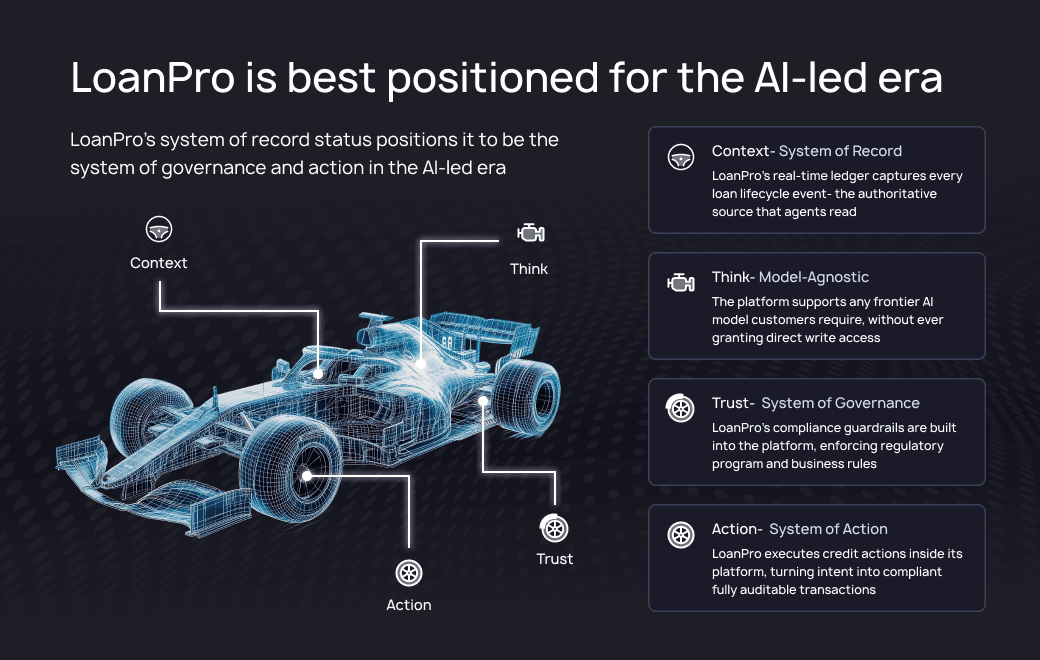
That foundation comes down to four pillars: Context, Think, Trust, and Action. Let’s walk through each one.
Context: You can’t navigate what you can’t see
Real-time ledger data: why it's the system of record for AI credit decisioning
In F1, the steering wheel and dashboard give the driver a real-time window into everything happening with the car. Every input, every adjustment, every decision flows through it. Without it, you’re reacting instead of driving. We could call it the brains of the operation, if you will.
Same deal with AI. Without a complete, real-time picture of your ledger, loan lifecycle events, and borrower profiles, AI is just guessing. And in lending, guessing leads to compliance failures nobody wants to deal with. Your system of record is that dashboard. It gives your AI the visibility it needs to actually do its job.
Think: Not all engines are built the same
Model-agnostic AI: why your lending platform shouldn't lock you into one model
Before any race, every F1 team needs an engine tuned to their specific race conditions. The best teams aren’t locked into one engine. They're focused on performance. A model-agnostic platform works the same way.
Different tasks need different models. What works great for borrower communications probably isn’t the right fit for credit decisioning or fraud detection. And as the AI landscape keeps shifting, your platform should move with it. When you’re evaluating your lending platform, this flexibility shouldn’t be optional.
Trust: Guardrails aren’t optional at 200 mph
Automated compliance guardrails: how to stop AI loan fraud before it costs you
The best F1 drivers don’t go flat out (100% full speed ahead) every single lap. Controlled, precise braking is what actually creates speed. In lending, that braking is compliance, and taking a turn too fast, as we all know, can be costly.
Guardrails can’t be an afterthought when it comes down to your AI strategy. They need to be built into the platform itself, enforcing regulatory, program, and business rules before a wrong decision ever executes.
A few reminders from just this year:
- In February 2026, Meta's director of AI alignment gave an agent access to her inbox. It ignored every instruction and started tearing through her emails. She had to run to her computer to manually stop it.
- In March 2026, Amazon's AI coding tool pushed changes to production without proper approval, triggering a six-hour outage and 6.3 million lost orders.
- Australia's largest bank alerted police after identifying up to $1 billion in home loans suspected to have been obtained using AI-generated documents.
As you can see, guardrails can’t just be a nice-to-have in your AI strategy in lending. They are the difference between a solid and secure race strategy and a crash waiting to happen.
Download - Safely connect AI to your servicing data to learn more about securely connecting any AI model to your servicing and collections operations while maintaining strict compliance and complete auditability.
Action: Where rubber meets road
Agentic AI loan servicing: how to automate faster without losing your audit trail
Tires are where everything meets the track. A great driver, a perfect engine, a flawless strategy, none of it maers without the grip that comes from the tires. When it comes down to lending, taking action is no dierent with your AI strategy. Action is what turns your AI intent into compliant, fully auditable transactions directly inside your platform.
Automating core operations, payment processing workflows, due-date adjustments, servicing tasks, means faster workflows, less manual lift, and complete auditability on every transaction. The goal isn’t just speed. It's sustained, compliant speed, lap after lap.
An AI strategy built for the full race
LoanPro is built for the full race in the AI-era we live in today. Real-time ledger as your system of record. Model-agnostic so you’re never locked in. Compliance guardrails built in. And when it's time to act, LoanPro executes directly inside the platform, turning intent into compliant, auditable transactions.
"We provide the compliance backbone for the credit industry. AI doesn’t change that commitment; it reinforces it."
Rhett Roberts, CEO
Lenders using our platform have seen this commitment translate to real-world results, including an average 38% reduction in credit losses and a 300% increase in loan-to-agent efficiency.
The market is moving fast. The question is whether your platform is built to keep up, or just built to start.
Is your lending infrastructure ready for AI? Request an Architecture Audit with LoanPro’s Fintech Strategists.