Your biggest roadblocks to lending platform modernization aren’t what you think
While most lenders consider platform modernization a priority, many continue to rely on legacy systems and have yet to complete the migration process, according to Carleton’s new Platform Migration and Modernization Survey.
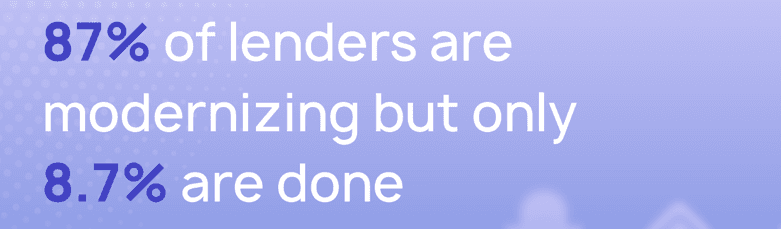
In fact, more than three-quarters of the 250 lending professionals that participated in the survey said the need to modernize their lending platforms is either extremely or very urgent. But, even though the majority (87%) say they are engaged in platform migration efforts, only 8.7% of respondents say they have fully completed the migration process. Another 23% said they are still considering migration without a defined timeline.
Why are so many lenders stuck? Many point to resource constraints and the costs of modernizing as their biggest roadblocks. But, cost and limited resources aren't preventing modernization. They're the result of legacy systems that demand constant maintenance, require extensive manual work, and keep accruing technical debt.
Migration cost isn’t the issue, maintenance is the real drain
The survey cites cost constraints (28.6%) and limited internal resources (31.6%) as the top two barriers. But, these aren't expenses and resources related to managing a modernization effort. It’s just keeping legacy infrastructure running.
A third of lenders report they spend 80% to 100% of their platform resources on maintenance, while another 4 in 10 spend between 60% to 80%.
Seven out of 10 lenders spend the majority of their resources just keeping the lights on.
Those spent resources represent an opportunity cost. Instead of maintaining aging infrastructure, lenders could redirect those same resources toward automation, product innovation, and portfolio growth. Here’s a few examples:
- Increased operational efficiency: LoanPro clients achieve an average 300% uptick in overall efficiencies by replacing manual data entry with automated workflows. This modernization allows lenders to drastically scale their loan portfolios without having to hire additional front-line staff.
- Faster loan delivery: One consumer lender was able to reduce loan delivery time by 97% and decrease manual labor by 3x by implementing automation to replace previously manual methods to loan servicing and management.
- Improved collections and reduced delinquencies: Leveraging autopay features as part of LoanPro’s loan management system, one lender was able to improve collections by more than 40% and reduce delinquencies with automated payment reminders.
- Increased growth: Auto lender, Modern Asset Management, switched to LoanPro and saw agents move from servicing 30 loans per month to 300 loans per month with increased automation — a 10x efficiency gain.
Every month spent supporting legacy systems is another month those same people, budgets, and hours aren't creating new value. Instead of continuing to waste time, resources, and money on maintaining legacy lending infrastructure, modernization shifts teams from preserving yesterday's technology to building tomorrow's lending business.
Migration timelines don’t have to be lengthy
Timelines are another factor many organizations point to as their barrier to modernization. Almost a third of respondents said a new product or regulatory change takes six months or more — with 12.7% of respondents reporting timelines longer than a year.
While many lenders assume modernization will require years of planning and implementation, today's API-first platforms can often go live in as little as three months and enable lenders to launch new products in just a few weeks. For example, Best Egg was able to launch
new programs and payment options in 60 days with LoanPro.
Compliance and security risk shouldn’t keep lenders from modernizing
Finally, compliance risk was the most frequently reported operational challenge, identified by 35.4% of respondents. What’s more, 30.2% of respondents said a security incident would be the most likely event to trigger modernization efforts.
But, waiting for a security event or compliance failure to justify modernization turns technology into a reactive investment. Modern lending platforms reduce that risk upfront by embedding compliance and security into everyday operations rather than layering them on afterward.
For instance, LoanPro’s Compliance Safeguard handles state-by-state regulatory updates and security standards automatically, generates required disclosures, and keeps a full audit trail.
A modern lending platform with hands-on migration support
A modern lending system is no longer a long-term investment that lenders can put off. It’s a competitive advantage, and it will soon be the cost of staying in the game.
Tim Yalich, vice president of business development at Carleton, put it another way: “Institutions still running on legacy systems … are not simply managing aging infrastructure. They are limiting their ability to compete, to grow into new states or asset classes, to integrate with modern fraud prevention tools, and to access the AI-enabled capabilities that are rapidly reshaping how lending decisions are made and monitored."
A disruption during a system transition (15.6% of respondents cite this as a concern) is a drop in the bucket compared to the efficiency, growth, and innovation gained by digital lending transformation.
Temporary migration challenges deserve careful planning, but they shouldn't outweigh the long-term operational costs of remaining on legacy infrastructure. The survey itself shows lenders recognize this, with nearly two-thirds identifying hands-on migration support as the most valuable resource during modernization.
LoanPro's implementation model is built specifically to address these concerns, offering dedicated consultants that act as an extension of the lender’s team and bulk account migration tools, legacy data transfer, and contract recreation to ensure everything transitions seamlessly.
Modernization doesn't have to mean disruption. With experienced implementation partners and proven migration tools, lenders can transition confidently while continuing to serve borrowers without interruption.
Learn how LoanPro helps lenders modernize faster with dedicated migration support and a proven implementation process.