The loan processing workflow, mapped
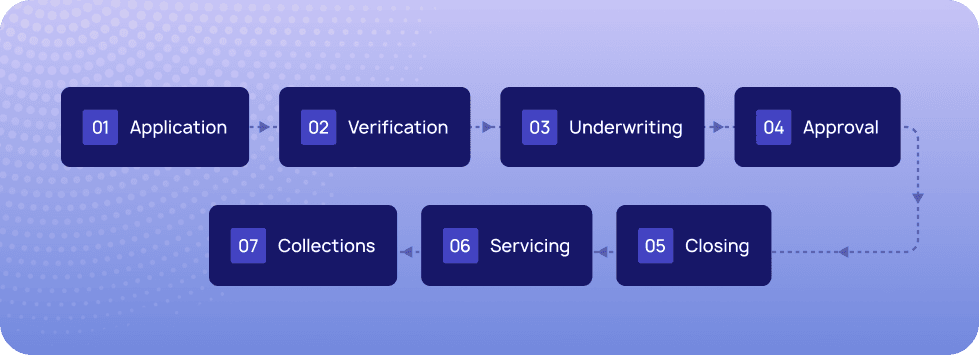
Every loan goes through the same basic journey, whether it's a $500 personal loan or a $500,000 commercial line of credit. A borrower applies, the lender verifies and evaluates that application, a decision gets made, funds move, and then the real work of managing that loan over time begins.
What varies is how much of that journey is manual and how much is automated, how many systems it touches along the way, and how many things quietly fall through the cracks between steps. Below is a clear map of the full workflow, from application to collections, along with where automation actually changes how each stage works in 2026.
Key takeaways
A loan processing workflow includes seven core stages: application and intake, verification, underwriting and decisioning, approval, closing and funding, servicing, and collections. Most breakdowns of this process stop at funding or fold collections into servicing, but collections deserves its own step since it involves distinct tools and workflows. Automation touches every stage differently, and understanding where it fits helps lenders spot where their own process has the most room to improve.
The stages of a loan processing workflow

1. Application and intake
The workflow starts when a borrower submits an application, whether through an online form, a mobile app, or in person. This stage is about collecting the right information up front: personal or business details, the requested loan amount, and any supporting documents.
The quality of this stage sets the tone for everything after it. A messy intake process means incomplete applications, more back and forth with borrowers, and delays before the loan even reaches underwriting. Many modern platforms use event-based webhook triggers here, so the moment an application comes in, downstream actions like document requests or identity checks can kick off automatically instead of waiting on a person to notice.
2. Verification
Once an application is submitted, the lender needs to confirm that the information in it is accurate. This includes identity verification, income and employment checks, and fraud or KYC screening depending on the type of loan.
Verification used to mean manually cross-checking documents against outside sources, a slow process prone to human error. Today, many lending platforms connect natively to credit bureaus, fraud databases, and identity verification providers, in LoanPro's case, over 100 data partners, so this information can be pulled and checked automatically rather than requested and reviewed one piece at a time.
3. Underwriting and decisioning
Underwriting is where the lender evaluates whether an applicant qualifies, and on what terms. This means analyzing credit history, debt-to-income ratio, collateral if applicable, and the lender's own risk policies.
This stage has changed the most over the past few years. Rules-based automated underwriting has been standard for a while now, evaluating applications against a lender's credit policy in seconds rather than days. What's newer in 2026 is AI that can reason across a loan's full context, not just check boxes against fixed rules, but weigh nuanced cases the way a human underwriter would, then flag the genuinely ambiguous ones for review instead of routing everything to a person. For a deeper look at how this works, see our guide to automated loan underwriting.
4. Approval
Once a decision is made, the lender needs to communicate it clearly and compliantly. This includes generating any required disclosures, whether the loan is approved, denied, or approved with different terms than requested.
This is a compliance-heavy stage, and it's an easy place for manual processes to create risk. A missed disclosure or an inconsistent adverse action notice can create real regulatory exposure. Automated compliance checks and disclosure generation reduce that risk by making sure the right documents go out consistently, every time, without relying on someone remembering the correct template.
5. Closing and funding
With the loan approved, the final paperwork gets signed and funds get disbursed. This stage involves generating the loan agreement, collecting signatures, and moving money, whether by ACH, card, or another method.
Real-time ledger systems matter here more than people often realize. When funding happens, the loan's balance, schedule, and terms need to be accurate immediately, not updated in a batch process hours or days later. That accuracy is what everything downstream, servicing, reporting, collections, depends on.
6. Servicing
Once a loan is funded, servicing begins, and it's usually the longest stage in a loan's life. This covers payment processing, statement generation, customer communication, and day-to-day account maintenance.
Servicing is where automation delivers a lot of quiet, ongoing value. Rule-based automation can handle routine tasks in the background, like applying payments, adjusting due dates, or sending scheduled communications, without a servicing agent touching every account manually. Borrower self-service tools, like the ability to view a payment schedule or update autopay, also reduce the volume of routine requests that would otherwise land on a support team. If you're evaluating platforms specifically for this stage, our breakdown of the top loan servicing software covers what to look for.
7. Collections
When a borrower falls behind, collections takes over. This includes delinquency tracking, outreach, and in some cases, hardship or loss mitigation programs.
Most explanations of the loan process treat collections as an afterthought, folded into servicing or skipped entirely. That undersells how distinct this stage actually is. Collections has its own workflows, its own compliance requirements, and its own tools, automated delinquency tracking and hardship program enrollment being two examples. The newest development here is AI agents that can monitor accounts for early risk signals and initiate the right outreach at the right time, within defined compliance guardrails, rather than waiting for a fixed schedule to trigger a review. For more on how that works, see our glossary entry on agentic loan servicing.
Where automation fits into loan processing
Looking at the seven stages together, a pattern shows up: automation isn't one feature bolted onto a loan platform, it's a layer that touches every stage differently. Intake and verification benefit from automated data pulls and triggers. Underwriting benefits from automated (and increasingly AI-assisted) decisioning. Servicing and collections benefit from rule-based background automation and, more recently, AI agents that can handle exceptions rather than just fixed rules.
The lenders who get the most value from automation tend to think about it across the whole workflow rather than fixing one stage in isolation. A fast, automated underwriting process doesn't help much if servicing is still manual and collections is still reactive.
How loan processing workflows differ by lender type or loan volume
Not every lender needs to automate every stage the same way. A small lender processing a few dozen loans a month might get most of their value from automating verification and reducing manual data entry, while a high-volume lender managing tens of thousands of accounts will feel the most pressure in underwriting consistency and servicing scale.
Loan type matters too. A short-term BNPL loan moves through this workflow in minutes, while a commercial loan might take weeks and involve far more manual underwriting judgment. The seven stages hold true either way, but how much time and automation each one needs will look different depending on what you're lending and how much of it you're doing.
See how LoanPro handles the full workflow
Every stage of this process runs on a single, configurable platform, from application through collections. Talk to our team to see things mapped out for your specific lending program.
Have questions? Checkout our FAQ:
What are the main stages of loan processing?
Most loan processing workflows include seven core stages: application and intake, verification, underwriting and decisioning, approval, closing and funding, servicing, and collections. Some breakdowns simplify this into four or five stages by combining steps, but the underlying work is the same.
What's the difference between loan processing and loan servicing?
Loan processing generally refers to everything that happens before a loan is funded, application, verification, underwriting, and approval. Loan servicing is everything that happens after funding, managing payments, communication, and the account itself for the life of the loan.
How long does loan processing take?
It depends heavily on loan type and how automated the process is. A simple, automated personal loan can be processed in minutes. A manually underwritten commercial loan can take weeks. Automation at the verification and underwriting stages is usually what has the biggest impact on turnaround time.
Why does collections get its own stage instead of falling under servicing?
Collections involves distinct workflows, compliance requirements, and tools that go beyond standard servicing, delinquency tracking, hardship programs, and specialized outreach among them. Treating it as its own stage gives it the attention it actually requires, rather than treating it as an edge case within servicing.