Loan on Card: a new way to deliver credit

Borrowers expect fast, intuitive access to credit. Yet the moment after a loan is approved can still feel surprisingly old-fashioned. A lender makes a decision, the borrower accepts the offer, and then they wait for funds to arrive.
Loan on Card gives lenders another way to deliver those funds in real time. Through Beyond Credit™, LoanPro combines the structure of an installment loan with the convenience of a Mastercard, giving borrowers immediate access to approved loan proceeds in their digital wallet.
The loan itself does not change. Lenders still set the terms, make the credit decision, originate the loan, and service the account. What changes is the mechanism for delivering and using the funds.
Key takeaways
- Loan on Card provides immediate access to loan funds via a mobile wallet. After selecting the card option, borrowers sign a cardholder agreement and consent to a behind the scenes KYC check before receiving a digital card in about a minute.
- Lenders gain more control and visibility. Lenders keep control of underwriting, loan terms, and servicing while Beyond Credit provides the card-based access mechanism. Card controls can restrict where and how funds are spent, while transaction data provides incredible insights into borrower behavior.
- Beyond Credit works for both one-time and ongoing expenses. Lenders can issue a single-use card for purpose specific loans or keep a card open for a defined period while the borrower makes payments on the loan.
- The card experience and the loan remain separate. Beyond Credit manages the zero fee, zero interest card program, while the lender remains responsible for the loan relationship, including underwriting, terms, and servicing.
What is Loan on Card?
Loan on Card delivers fixed-term installment loans directly to borrowers via a Mastercard credential that can be provisioned 24/7 365 days a year to their mobile wallet. It's not a revolving credit card or pre-paid debit card. It's a loan with card-based access.
The lender still determines whether a borrower qualifies, how much they can borrow, the interest rate fees, and repayment terms. Beyond Credit provides the mechanism that makes those approved funds available through a Loan on Card.
Once issued, the card can be used for online purchases or provisioned to a mobile wallet for tap-to-pay transactions wherever Mastercard is accepted.
Where Beyond Credit fits
Beyond Credit, a wholly-owned subsidiary of LoanPro, manages the issuance and support of cards for a lender’s borrowers.
Once a borrower has been approved and accepts a loan, a lender can offer a choice of funding methods, such as ACH or a digitally-issued card. If the borrower chooses Loan on Card, the lender passes the required borrower information to Beyond Credit through an API.
Beyond Credit then manages the card issuance experience, including the card holder agreement, frictionless KYC, card provisioning, transaction processing, and card-related support.
This separation is important. Beyond Credit does not approve or decline access to credit. It provides an alternative solution to make the lender's approved funds available.
How a borrower actually gets funds
The borrower experience is designed to happen immediately after loan approval.
First, the borrower completes the lender's normal application, underwriting, verification (KYC), and origination process. Once approved, the borrower chooses how to receive the funds.
If they select the digital card option, the lender redirects them into the Beyond Credit experience and passes along information already collected during the loan application.
From there, the borrower:
- Verifies their mobile phone number.
- Provides consent for the required identity check.
- Reviews and accepts the applicable card agreements and disclosures.
- Receives their digitally issued card.
- Adds the card to their mobile wallet or uses the card credentials for online purchases.
The entire experience takes less than two minutes. After card issuance the borrower may begin transacting immediately.
The full loan amount is available through the card, even if the borrower ultimately spends less than that amount. For example, if a borrower receives a $1,000 one time use card and spends $887, the remaining $113 can be handled according to the lender's program. The lender can send the unused funds to the borrower through ACH or apply them to the principal balance of the loan, potentially reducing or recasting the remaining balance.
How it works for lenders
For lenders, the process is straightforward:
- Approve the loan using your existing underwriting criteria.
- Offer the borrower a choice of ACH or card-based access to the proceeds.
- Pass the required borrower and loan data to Beyond Credit.
- Beyond Credit provisions the Mastercard credential and makes it available to the borrower.
- The borrower uses the funds anywhere Mastercard is accepted, or within any restrictions configured by the lender.
- Wire the loan origination amount to their dedicated account at Cross River Bank
- Receive card and transaction data back from Beyond Credit daily.
- Continue collecting predictable payments according to the loan's existing terms.
LoanPro manages relationships with the issuing bank, processor, and Mastercard network to provide the card infrastructure. The lender does not have to build or operate its own card program to offer this type of access.
How borrower identity verification works
The lender remains responsible for its own KYC and AML processes as part of loan origination. Beyond Credit has a separate obligation to it’s bank sponsor to verify the identity of consumers receiving a card through its program.
At the time that the borrower is redirected to the Beyond Credit experience the lender passes borrower details behind the scenes to Beyond Credit, who, after collecting borrower consent, submits it to its KYC provider for validation.
After successful KYC, the card is issued in real time. If Beyond Credit can’t confirm a borrower’s identity instantly or after step up verification the borrower is directed back to the lender to receive access to funds via an alternative method.
That separation keeps the lending decision with the lender and the card issuance decision with the card program.
What the lender controls
Loan on Card gives lenders control over both the loan and how its proceeds can be used. Depending on the loan program, lenders can:
- Allow spending anywhere Mastercard is accepted.
- Restrict spending to a specific merchant.
- Restrict spending to specific merchant categories using merchant category codes.
- Set a defined period during which the card can be used.
- Issue a single-use card for a one-time expense.
- Keep a card active for ongoing purchases during a defined project or period.
- Determine the loan amount, pricing, repayment schedule, and other loan terms.
This can create a more configurable lending experience without requiring the lender to build an individual integration with every merchant where borrowers may want to spend their funds.
Who does what
Loan on Card works because the responsibilities for the lender and the card issuer are deliberately separated.
The lender manages the loan. That includes customer acquisition, application, underwriting, KYC, loan approval, origination, loan terms, interest and fees, servicing, and borrower questions related to the loan.
Beyond Credit manages the card. That includes card issuance, card-related KYC validation, card credentials, wallet provisioning, card transactions, disputes, chargebacks, and card fraud.
The issuing bank provides the banking infrastructure. Cross River Bank serves as the BIN sponsor for the card program.
Galileo provides issuing and processing infrastructure, while Mastercard provides the payment network through which the card can be used.
The result is a division of responsibilities that lets lenders add card-based loan access without taking on the full operational burden of launching a credit card program themselves.
Key benefits of Beyond Credit
Instant competitive advantage
Speed matters, particularly when a borrower needs credit for something happening in life right now.
A broken refrigerator does not wait for Monday morning ACH processes. Neither does an emergency tire replacement. When borrowers can access approved funds immediately through their mobile wallet, you're delivering a best-in-class experience that eliminates the friction between approval and usage.
The real time capability creates a new path to point-of-sale lending. A lender can partner with a merchant or retailer, direct a borrower into its existing application process, approve the loan, and deliver the proceeds through a digital card without building a separate checkout integration.
Complete program control
Loan on Card gives lenders control over how their approved credit can be used. With Beyond Credit, lenders decide where funds can be spent (anywhere Mastercard is accepted, specific merchants, or industry verticals), within what timeframe (set spend windows like 30 days), the terms of the loan, and how interest, fees, and promotions are applied.
They maintain ownership of the borrower relationship, underwriting decisions, and product terms while leveraging Mastercard's global infrastructure.
Enhanced borrower satisfaction
Borrowers get immediate mobile wallet access, universal acceptance anywhere Mastercard works, predictable fixed payments without revolving balances, and the security of the Mastercard network.
Expanded market opportunities
Loan on Card supports a broad range of lending use cases, from emergency expenses and home improvement, to healthcare, auto repair, and point-of-sale purchases. That flexibility helps lenders reach borrowers in the moments when they need credit, rather than requiring them to apply for a loan and then wait up to days for proceeds to arrive.
It also makes smaller-dollar lending, like Buy Now, Pay Later (BNPL), more practical for traditional installment lenders. A lender that formerly relied on ACH for larger installment loans can use card-based access to support smaller purchases where immediate availability and convenience matter more.
Stronger customer relationships
Digitally issued credit card loan access also gives lenders something ACH cannot: full visibility into how loan proceeds are actually used. Beyond Credit provides insights on merchant information, transaction timing, categories, descriptions, subscription indicators, and other transaction details.
That information tells a story on borrower needs and behavior, identifies patterns in how different loan products are used, and informs customer acquisition and product strategies.
The future of lending is digital
Loan approval is only part of the borrower experience. What happens next determines whether the process felt seamless or frustrating.
Loan on Card gives lenders another way to close that gap. Instead of approving a loan and sending the borrower away to wait for an ACH deposit, lenders can make loan funds available through Beyond Credit in minutes regardless of nights, weekends or holidays.
For lenders looking to expand into point-of-sale lending, support more immediate borrowing needs, or modernize the way installment loans are delivered, Beyond Credit creates a fundamentally different path from traditional disbursement.
Ready to modernize your lending operations?
Contact me at mike.simmons@loanpro.io to walk through card-based disbursement alongside your current origination and servicing setup.
Or start with my Salt Flats Summit session on how Loan on Card works. Watch the session.
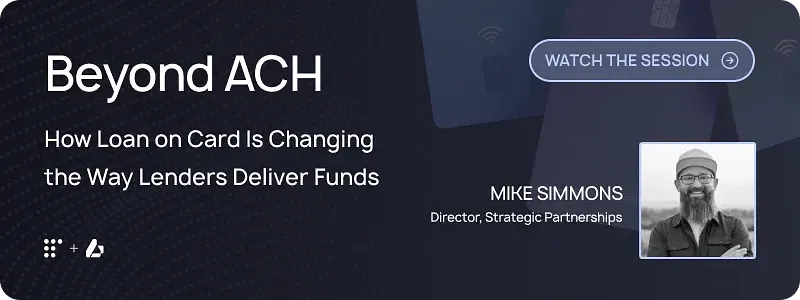
When I presented Loan on Card at Salt Flats Summit 2026, the second half of the session was questions from lenders in the room. The FAQ below lists the ones that came up most, but you can watch the full session at the link above.
Have questions? Checkout our FAQ:
What happens if a borrower fails KYC?
If the borrower cannot be validated for a Loan on Card, Beyond Credit does not decline the underlying loan. The borrower is directed back to the lender to use an alternative funding method, such as ACH.
Why is there a second KYC if the lender already ran one?
The lender and Beyond Credit have separate regulatory and operational responsibilities.
The lender conducts KYC and AML procedures as part of deciding whether to extend the loan. Beyond Credit has its own obligation as the card program manager and must validate the identity of the person receiving the card. Beyond Credit uses the information the lender already collected, so the borrower does not have to provide all of their information again.
What happens to funds the borrower doesn't spend, and does that count as a payment against the loan?
The full approved loan amount is made available to the borrower through the card mechanism, even if the borrower ultimately spends less than that amount.
For example, if a borrower receives a $1,000 card and spends $887, the remaining $113 can be handled in different ways. The lender can send the remaining amount to the borrower through ACH, or it can apply the unused amount to the principal balance of the loan and potentially recast the loan.
The specific treatment depends on the lender's program and loan terms.
Can a borrower get another card after the first is canceled?
Yes. A lender can initiate the issuance of another card through the Beyond Credit API.
This can support multiple draws against a line of credit or additional loans over time. Each card can be configured based on the lender's program and the borrower's needs.
How does this work for a line of credit rather than an installment loan?
A line of credit can be structured as a series of individual draws.
For example, a borrower could receive a $5,000 line of credit and request a $1,000 draw. Beyond Credit would issue a card for that draw. Once the borrower uses the card, it can be canceled, and any unused amount can be returned to the available line.
When the borrower wants another draw, the lender can initiate another card issuance.
Does Reg Z apply, and who owns it?
Regulation Z applies to the card program and is managed by Beyond Credit on the card side.
The lender remains responsible for the underlying loan and its applicable requirements. The lender of record for the loan may be the lender itself or another financial institution, depending on the lending structure.
This creates two distinct relationships: the lender relationship governing the loan and the card program relationship governing card issuance.
Do borrowers get the same network protections as a normal credit card?
Yes. The card operates on the Mastercard credit network, so borrowers receive the network protections and benefits associated with Mastercard transactions.
Beyond Credit also manages card-related disputes, chargebacks, and card fraud. Questions about the underlying loan, including loan terms and servicing, remain with the lender.
What are the card limits and minimums?
There is no single universal card limit. The appropriate amount depends on the lender's loan program and the nature of the transaction.
Loan on Card can support both larger installment loans and smaller-dollar purchases. The card mechanism itself can be configured around the amount of credit the lender has approved.
Is there a commercial BIN?
Not yet. Today, Beyond Credit has a consumer BIN. A commercial BIN is planned as a future capability, with timing dependent on customer demand and program requirements.
What does the borrower pay?
Beyond Credit does not charge the borrower card fees or interest. The borrower remains responsible for the terms of the underlying loan, including any interest, fees, or other charges established by the lender.
Is there a physical card for this?
No, Beyond Credit works by adding a virtual card to the mobile wallet on a consumer’s device, like Apple Pay or Google Pay.